![]()
Past Papers — Gauteng 2023 Memo
- Unit 1: Macroscopic Properties
- Unit 2: States of Matter and Kinetic Molecular Theory
- Unit 3: The Atom: The Basic Building Block of all Matter
- Unit 4: The Periodic Table
- Unit 5: Chemical Bonds
- Unit 6: Matter is Composed of Particles
- Unit 7: Physical and Chemical Change
- Unit 8: Writing and Balancing Chemical Reaction Equations
- Unit 9: Reactions in Aqueous Solutions
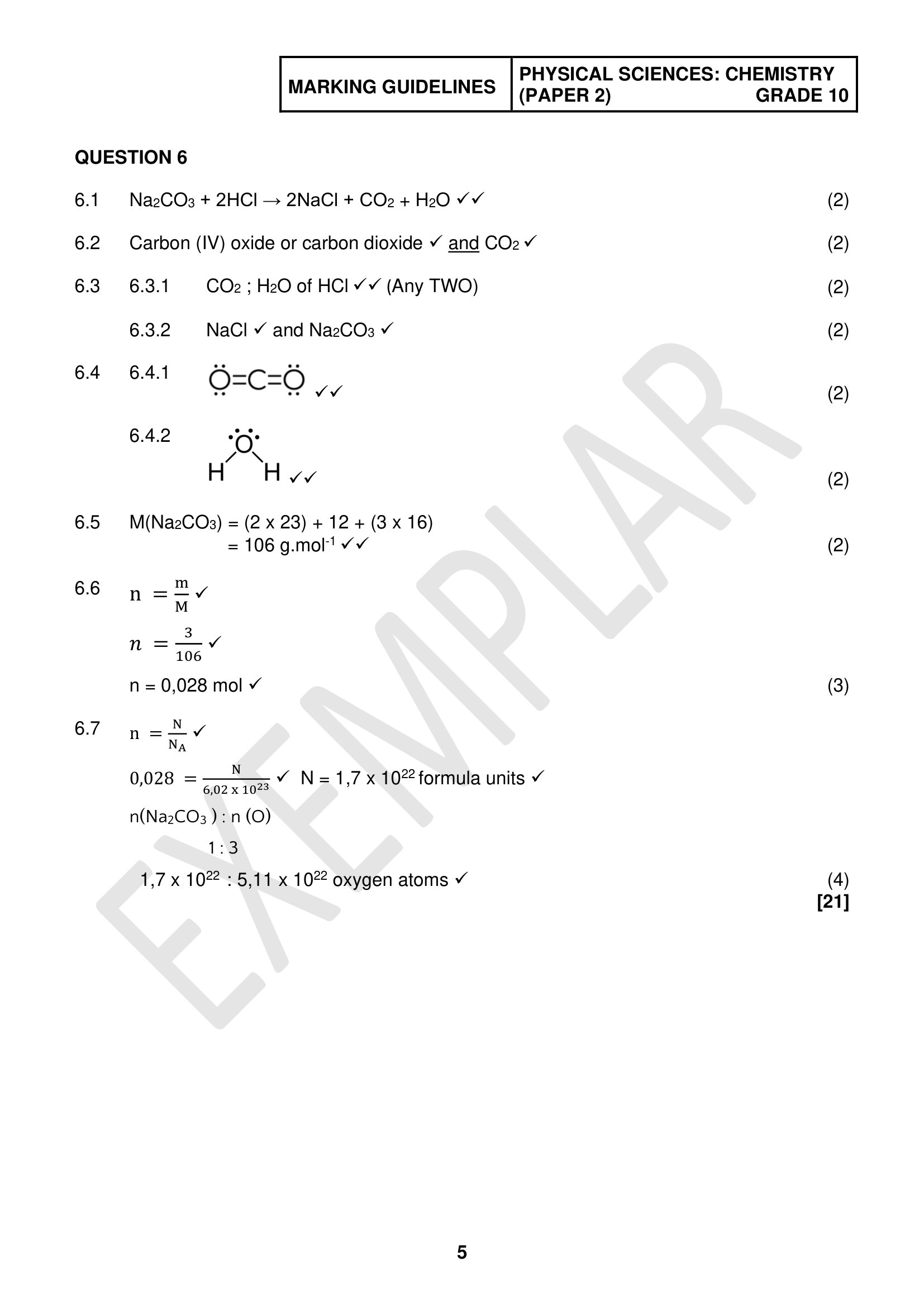
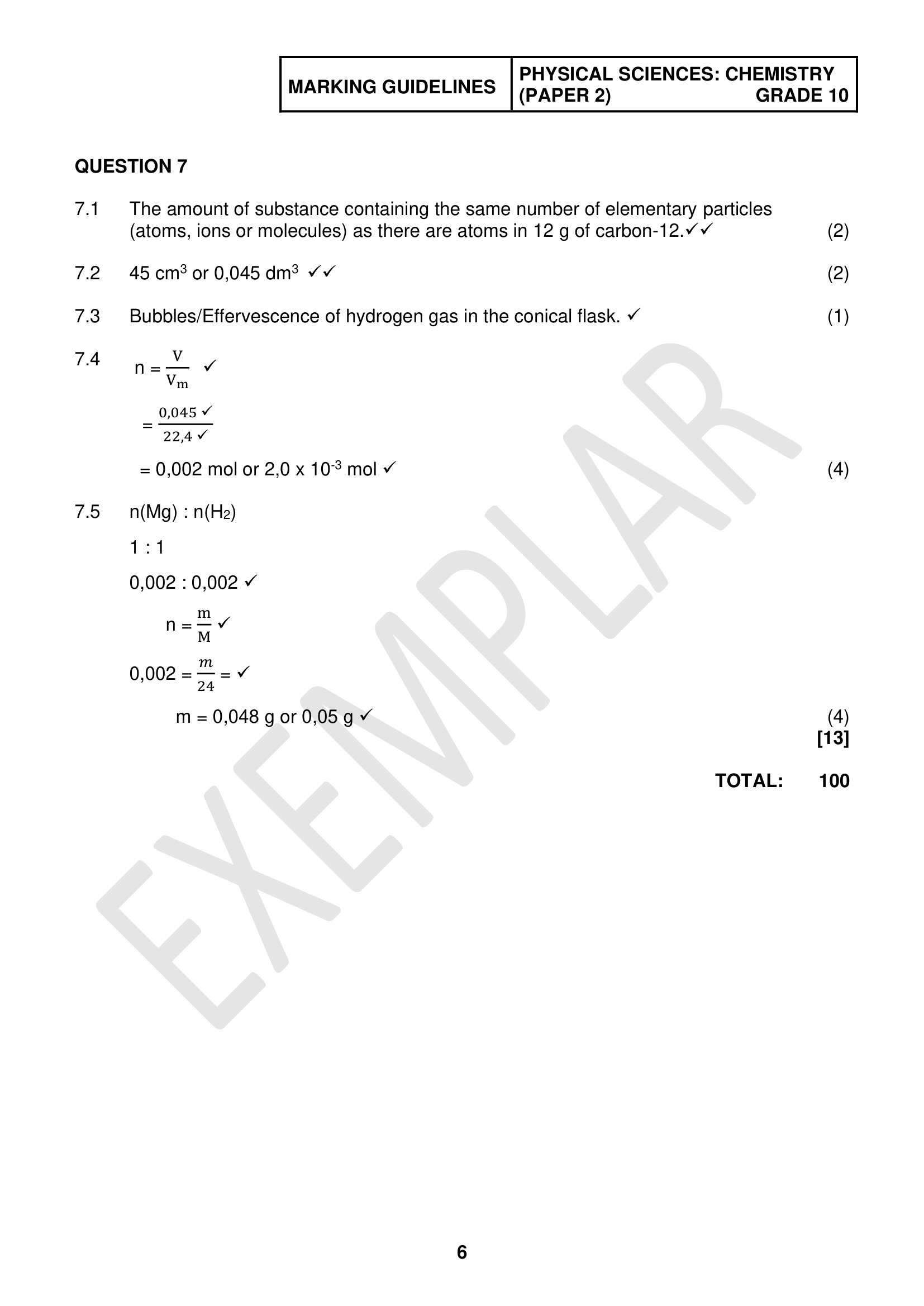
- Unit 10: Quantitative Aspects of Chemical Change
Properties of materials:
- Strength
- Thermal and electrical conductivity
- Brittle, malleable, and ductile
- Magnetic or non-magnetic
- Density
- Melting points and boiling points
Classification of substances:
- What products are made of: atoms or molecules
- Elements or compounds
- Pure substances (element or compound) vs mixtures
- Mixtures: homogeneous or heterogeneous
Names of formulae and substances:
- Learn cation and anion tables
- Includes polyatomic ions (e.g. sulfate SO₄²⁻, nitrite NO₂⁻, hydroxide OH⁻, phosphate PO₄³⁻)
- Common household/traditional names (e.g. H₂O: water, HCl: hydrochloric acid, NH₃: ammonia, CO₂: carbon dioxide, H₂SO₄: sulfuric acid)
- Understanding scientific language for naming compounds (e.g. oxide)
Classification of metals, metalloids, and non-metals:
- Learn the properties of each
- Metalloids (semi-metals): understand their applications
States of matter:
- Verify particle nature by investigating diffusion and Brownian motion
- Characteristics of the three phases of matter
- Define freezing, melting, and boiling points
- Identify state of a substance given temperature, melting, and boiling points
- Define melting, evaporation, freezing, sublimation, condensation
Kinetic molecular theory:
- Describe solid, liquid, and gas in terms of kinetic molecular theory
- Describe phase changes using kinetic molecular theory
- Brownian motion and diffusion
- Heating and cooling curves
- Recognize phase changes on heating and cooling curves
- Understand that temperature does not change during phase changes
Atomic models:
- Know major contributions by Rutherford, Bohr, etc.
- Purpose of the atomic structure model
Atomic mass and structure:
- Atom is mainly empty space, nucleus is small
- Know structure: protons, neutrons, electrons
- Use periodic table to find atomic number, number of protons, electrons
- Understand ions: removing electrons changes neutrality, determine charge
- Calculate number of neutrons
- Calculate mass number of isotopes
Isotopes and relative atomic mass:
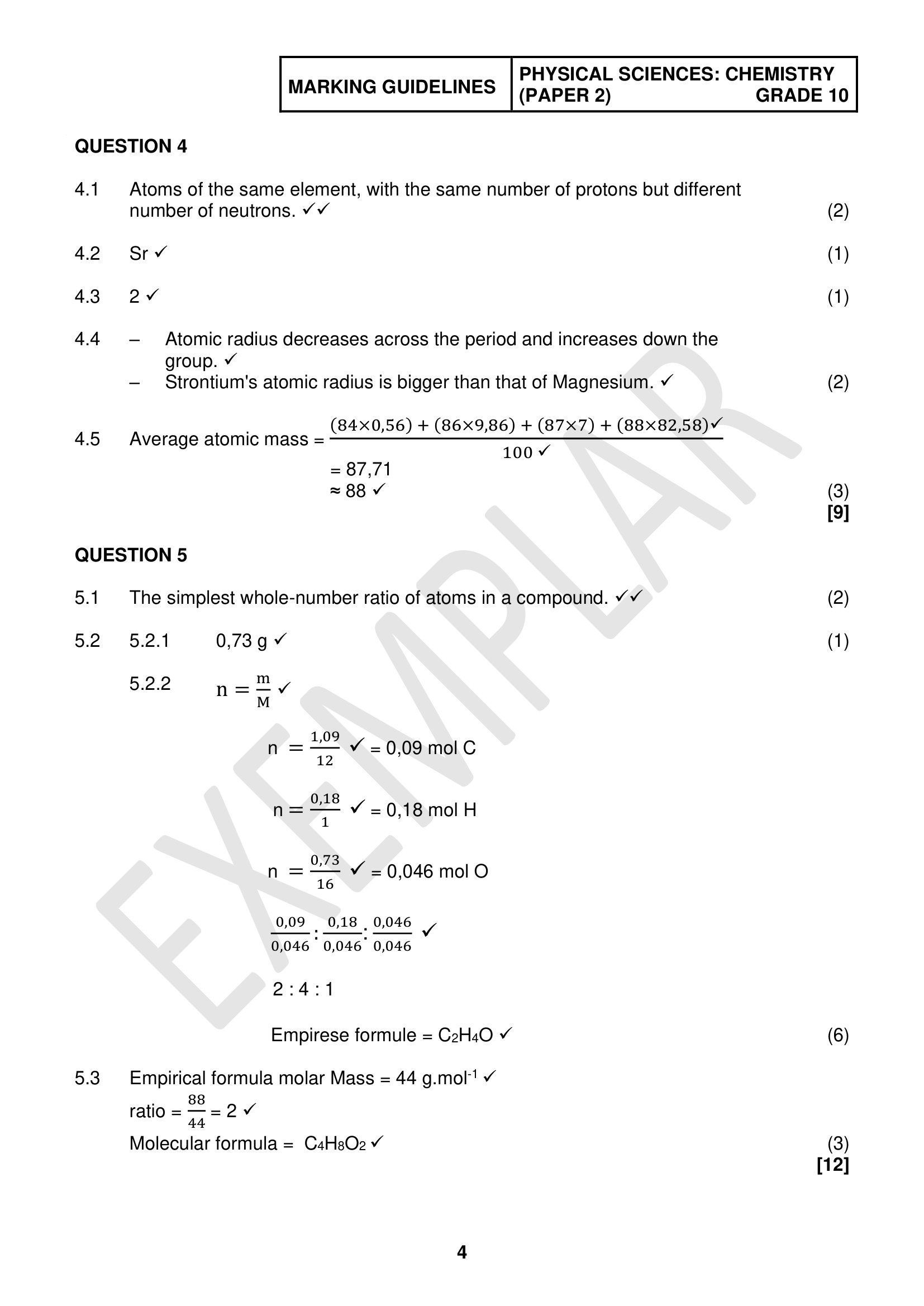
- Calculate relative atomic mass from isotope percentage abundances
Electron configuration:
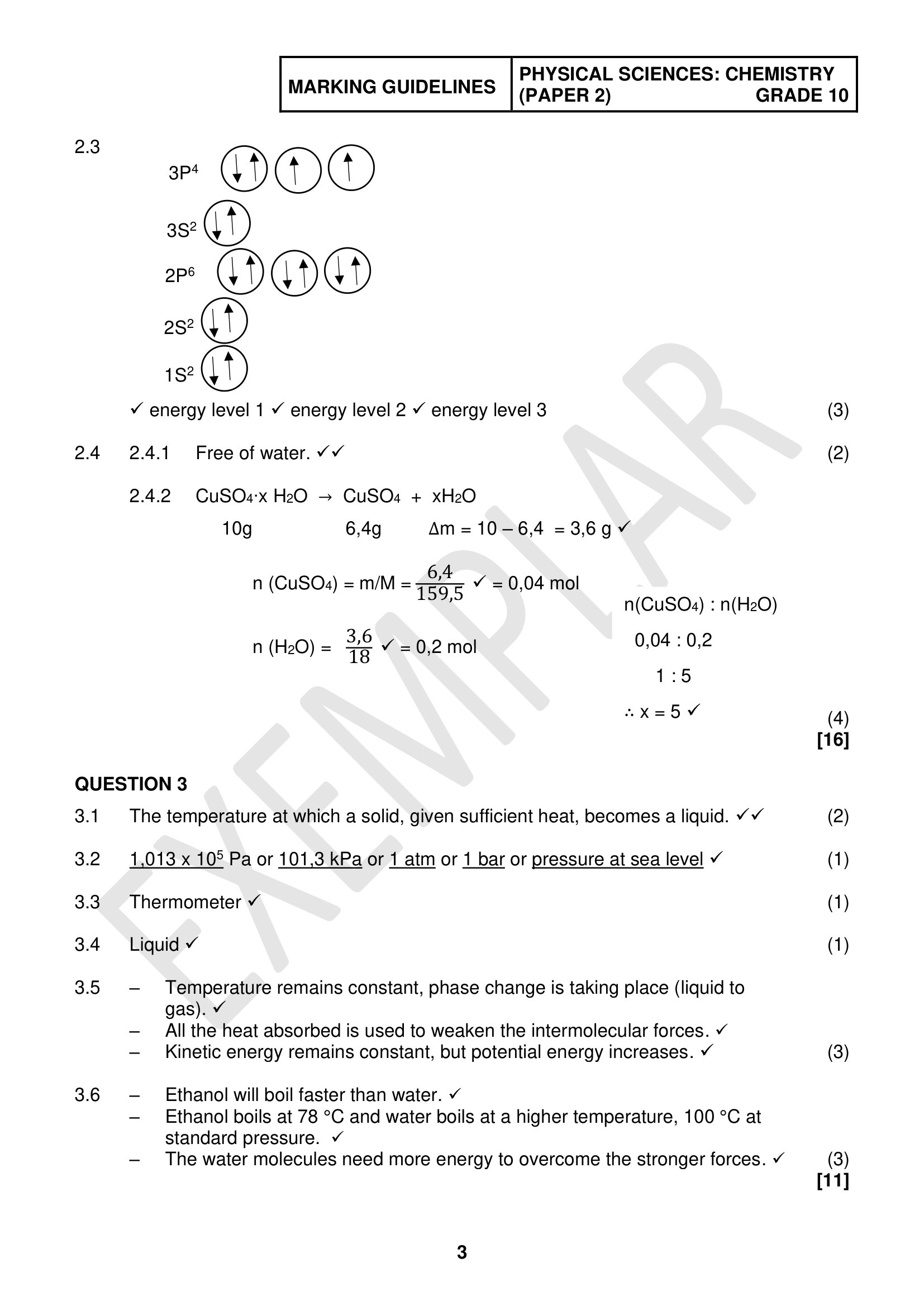
- Draw orbital box diagrams
- Use spectroscopic electron configuration notation (Aufbau principle)
- Describe atomic orbitals, shape of s and p orbitals
- State Hund's rule and Pauli's exclusion principle
Position of elements and electronic arrangements:
- Table arranged by ascending atomic number
- Define group number and period number
- Relate position to electronic structure
- Understand periodicity of density, melting/boiling points, atomic radius
- Influence of periodicity on electron affinity and electronegativity
- Define atomic radius, ionization energy, electron affinity, electronegativity
Trends in the periodic table:
- Know trends: atomic radius, ionization energy changes up/down, left/right
Groups and reactivity:
- Relate electronic arrangements to properties of Groups 1, 2, 17, 18
- Describe differences in reactivity of Groups 1, 2, 17
- Predict properties of these groups
Location of different elements:
- Indicate location of metals, non-metals, and transition metals
Covalent Bonding:
- Draw Lewis dot diagrams of elements
- Sharing of electrons forms covalent bonds (single, double, triple)
- Electron diagrams of simple covalent bonds
- Names and formulae of covalent compounds
- Between non-metals, form molecules or giant network structures (e.g. diamond, graphite)
Ionic Bonding:
- Transfer of electrons forms ionic bonds (cations, anions)
- Electron diagrams of simple ionic compounds
- Ionic structure: crystal lattice
Metallic Bonding:
- Sharing of delocalized electron cloud among positive nuclei