
African Art
Saharan petroglyphs record pastoral memory, Yoruba, Dogon, and Baule masquerades animate carved figures with textiles and rhythm, and global comparisons trace how these forms reverberate through modern sculpture and museum collections.
Introduction
Background
Africa is a vast continent made up of many diverse cultural groups that have always existed and continue to evolve. When we refer to “traditional African art,” we usually mean the masks, figures, relief carvings, and objects created in Pre-Colonial Africa — that is, before European countries made advances into Africa. These art forms are deeply rooted in socio-political and religious belief systems. Colonisation played a major role in Africa’s history and intensified during the Industrial Revolution in the 19th century as European countries sought raw materials; since the 1960s, most African nations have gained independence.Ritual/Festival figure
This tribal figure is an example of art used for ritual or festival purposes. The figure is completely camouflaged to take on a new spiritual identity. The costume is made up of colourful cloth, a mask, and decorations such as beads, shells, and other natural materials. During performances, the figure sways and dances while music is played on instruments like drums. This particular example represents modern times, as it features a painted mask topped with a model of a bicycle. There are few surviving examples from earlier times because materials used did not last and there were no cameras to record them. Such figures were used to reveal tribal history or customs and to entertain during important ceremonies.Belief systems
For traditional African people, the spiritual and physical worlds are closely connected. Spirits are believed to constantly interact with humans and nature, requiring attention and appeasement through rituals and offerings. Elders used ceremonies and rituals not only for religious purposes but also to teach and discipline the young according to tribal customs. Initiation ceremonies for young boys traditionally took place away from the village in secluded camps, where older men — often wearing masks — taught tribal histories, moral conduct, practical survival skills, and responsibilities within the community. Women were also honoured, particularly for fertility, which symbolised life and continuity. In later centuries, world religions such as Christianity and Islam spread across Africa, influencing many belief systems while traditional spiritual practices continued to persist.African Rock Art (Overview) Unknown
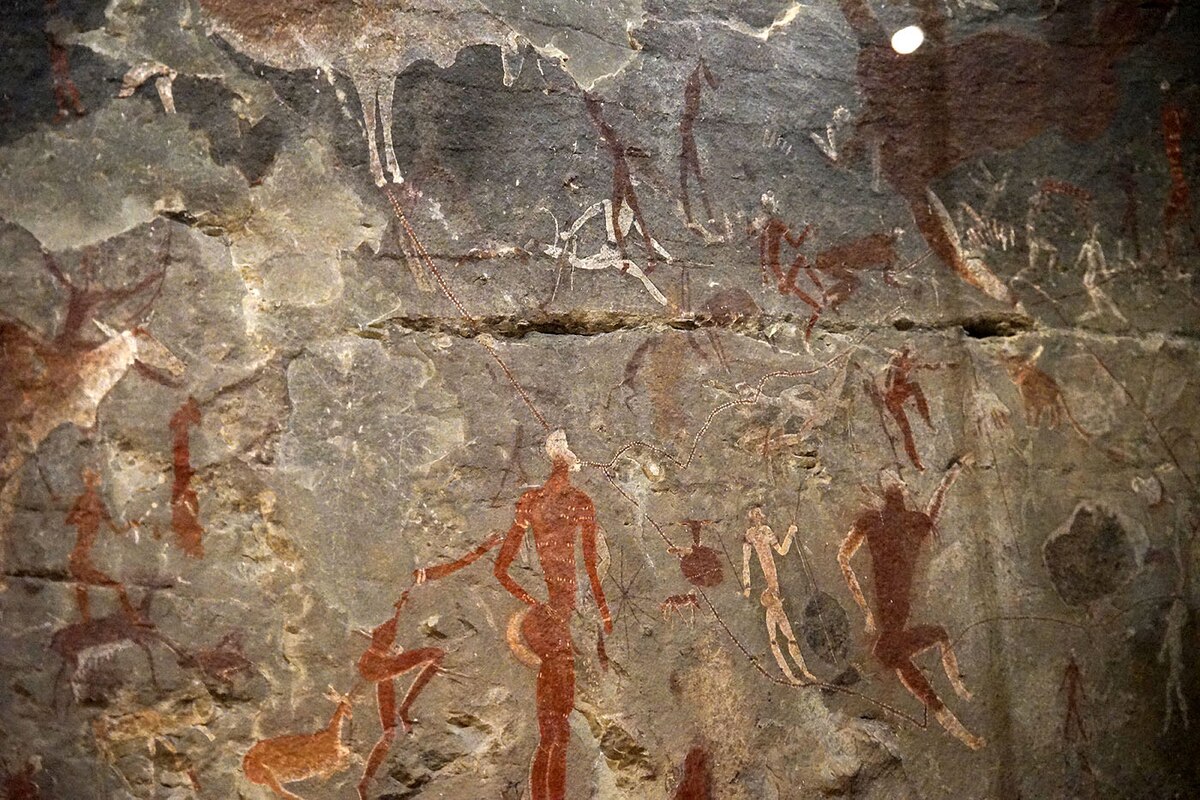
Snapshot:
- Typically found where eroded rock faces form shelters or overhangs — in plain English: under rock overhangs and in shallow caves.
- Appears as rock paintings (pictographs) and rock engravings (petroglyphs) — in plain English: painted images and scratched/carved images.
- Common themes: animals, hunting scenes, trance dances, rainmaking; later, colonial subjects like wagons and soldiers — in plain English: pictures about survival, spirit rituals, and encounters with newcomers.
Subject & Iconography:
- Animals and hunting action; trance and rainmaking scenes; later additions of wagons, horses, and soldiers record changing times.
- Figures may appear “camouflaged” with animal heads/skins; lines, arrows, and droplets can indicate simulated hunts, bloodlines, sweat, power, or transformation.
- Portraits and children are rare, suggesting a belief that a person’s image is spiritually powerful.
Formal Analysis:
- Artists convey movement and perspective (e.g., a buck turning its head over its shoulder — foreshortening).
- Some figures have elongated limbs — possibly symbolising added energy or endurance for long hunts.
- Engravings use simple, economical lines that still capture lifelike motion.
Materials & Technique:
- Pigments from clay, rocks, plants, charcoal, and guano, mixed with binders like blood, animal fat, and other liquids — in plain English: natural powders plus sticky binders.
- Tools/methods: flattened twigs, animal-hair brushes, finger painting with warm paint-and-fat mixes, and blowing paint through hollow bones or reeds — in plain English: brushes, fingers, and simple “airbrush” tubes.
- In some places (e.g., the Cederberg) fat preserved the paint so well that surrounding rock weathered faster.
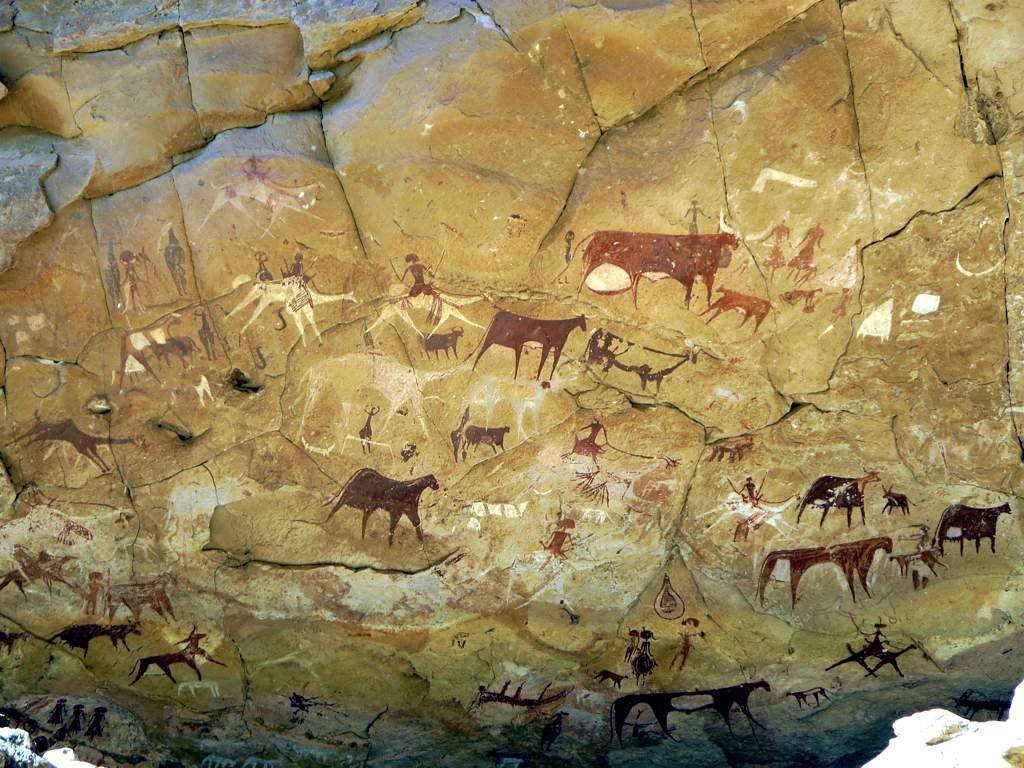
Function & Context:
- Images were not merely decorative; they expressed spiritual energy and emotional intensity tied to hunting and survival.
- Shamans performed rituals and trance dances at sites to ensure hunting success, bring rain, or heal; trance could be induced by rhythmic dance, music, plants, or bloodletting.
- Paint could include animal or human blood, symbolically linking people and animals.
- Distribution: paintings cluster in sheltered rock; petroglyphs often occur on exposed plains.
Style & Period Features:
- Early paintings: simple symbols, single figures, and monochrome animal silhouettes (black or red) — in plain English: simple one-colour shapes.
- Later paintings: smooth grading from beige/white to reddish-brown/dark brown, creating polychrome effects — in plain English: more colours and gentle shading.
- Technique contrast: colour-rich paint vs the elegant, spare line of engravings.
Interpretation:
- Central idea: transformation and connection between human and animal spirit-power, with shamans as mediators — in plain English: art as a bridge to the spirit world.
- Images sought practical outcomes (food, rain, healing) through spiritual action — in plain English: paint the power to change real life.
- Later colonial subjects serve as visual records of new arrivals and technologies.
Comparison:
- Cross-continental echoes: large animal subjects and negative handprints (e.g., Southern Africa and Lascaux in France) — similar solutions to similar needs.
- Technique contrast: polychrome shading in paintings vs spare, precise line in engravings.
- Time/place: paintings in sheltered rock; engravings on exposed plains.
Condition/Changes:
- Erosion removes earlier layers; what remains can be relatively recent — in plain English: the weather is the main enemy.
- Some binders (fat) accidentally protected paint; elsewhere, exposure has faded surfaces — materials and shelter make a big difference.
- Restoration is limited by ethics and fragility; documentation and controlled access are safer than heavy “fixing.”
African Tribal Art Various makers

African Civilisations:
- Across thousands of years, African peoples produced diverse artworks, structures, and masks. Many early works did not survive because materials were perishable, and histories were preserved mainly through oral tradition.
- While Egypt is well known (treated separately), historians also identify many significant sub-Saharan civilisations across West, Central, and Southern Africa.
Key Civilisations & Timelines:
- Nok civilisation (near the Niger River): c. 500 BCE–2nd century CE; among the earliest known in West Africa.
- Ife: rises c. 11th century CE (European Middle Ages).
- Benin: flourishes c. 11th–16th centuries CE (contemporary with the European Renaissance).
- Central Africa (Congo River basin): dates still under study; ongoing archaeological discoveries.
- Southern Africa: artefacts like the Lydenburg Heads suggest established culture by the 6th century CE.
- Zimbabwe: advanced civilisation, c. 11th–16th centuries.
- Mapungubwe: prosperous community c. 1200–1300 CE.
Nok Terracotta Head (Nigeria):
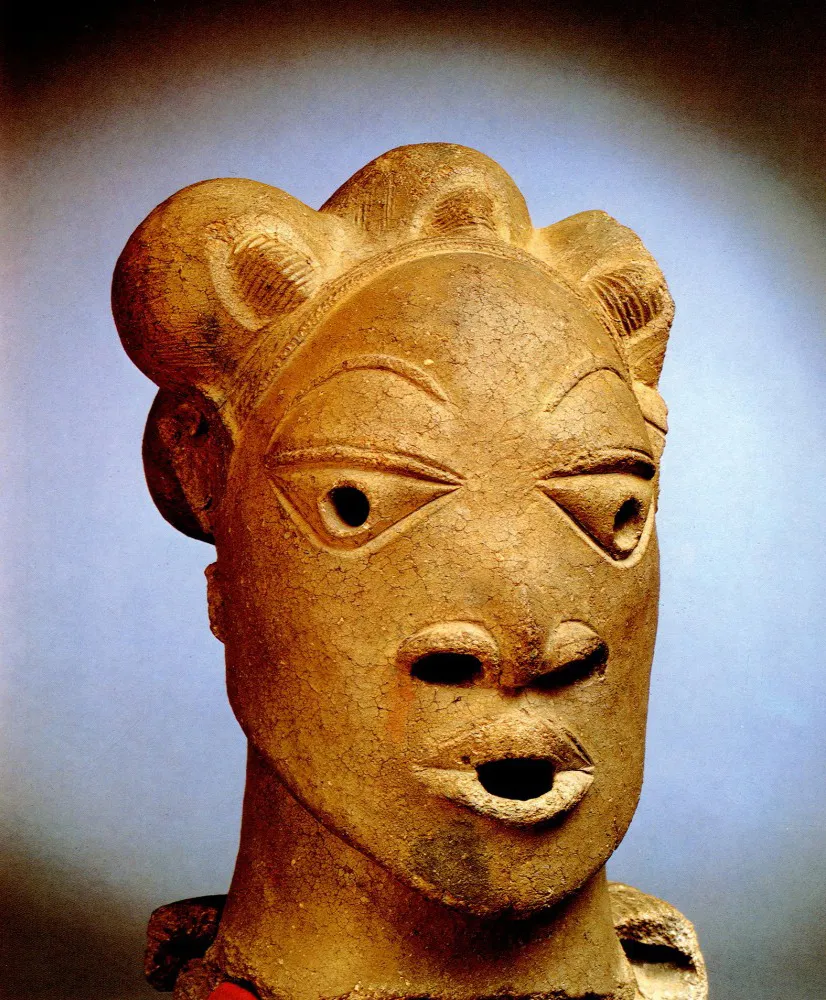
- Among the oldest Nigerian sculptures; found near a grave and shrine, likely honouring ancestors.
- Stylised features: rounded hollows for eyes, triangular nasal opening; elaborate hairstyle likely represents plaited hair.
- Vents in nostrils and mouth aided the firing of the terracotta.
Ife Royal Head (Yoruba):
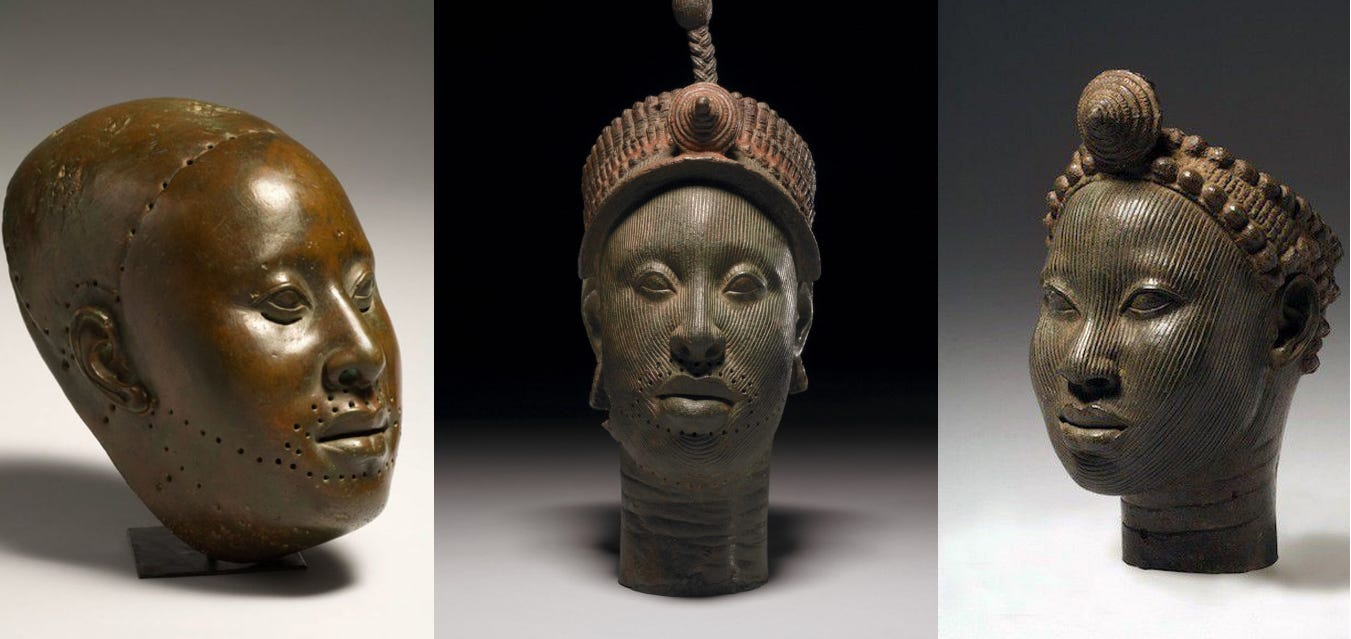
- Enlarged head signifies intelligence and leadership.
- Notably naturalistic compared with earlier geometric/abstract carving; rounded features and lifelike proportion.
- Ornate headpiece and jewellery symbolise royal power.
Benin: Head of the Queen Mother (16th c.):
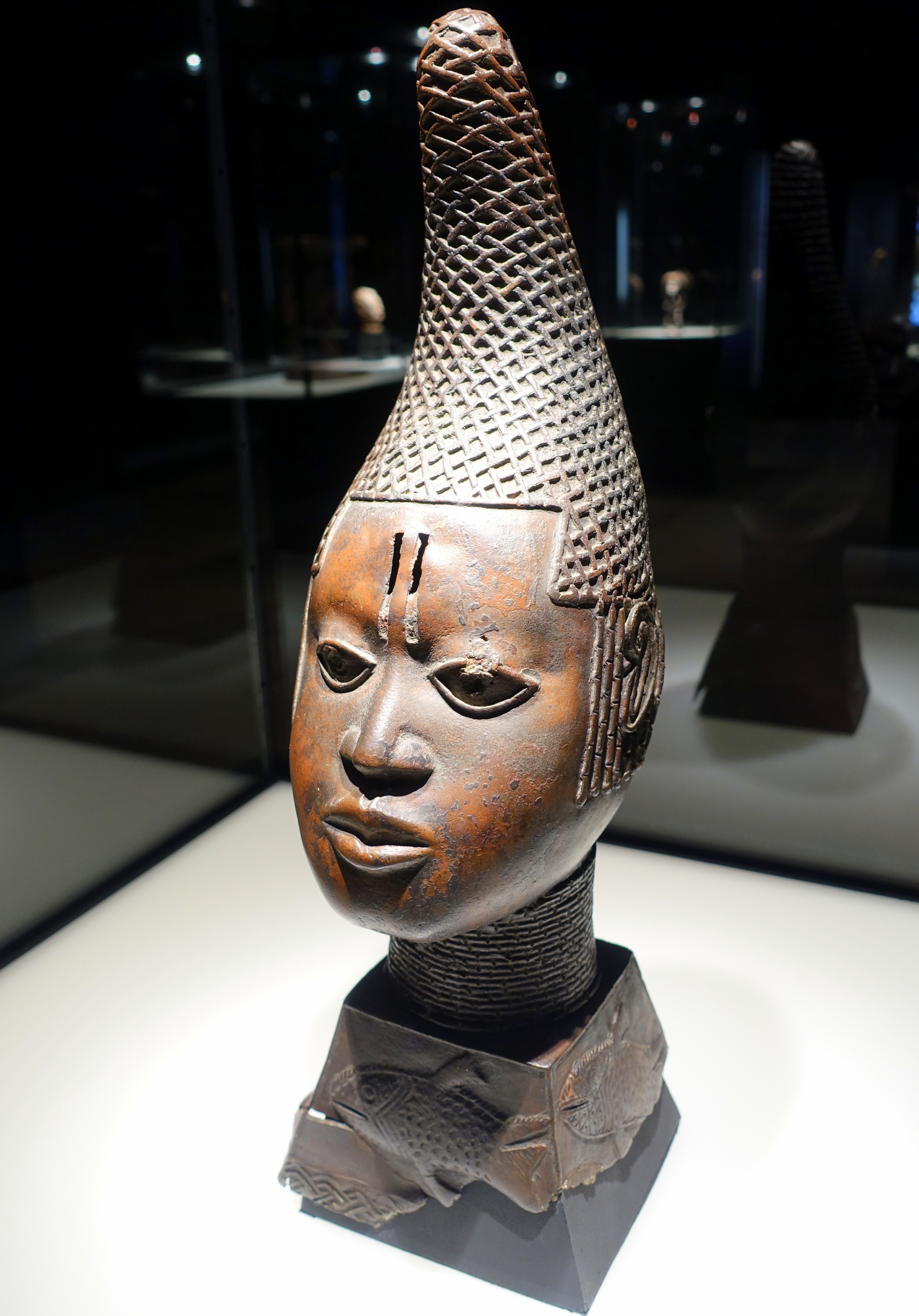
- Cone-shaped headdress (woven/plaited hair), choker necklace, and fish motifs at the base reflecting customs.
- Calm, poised expression invites comparison with Renaissance realism.
Central Africa: Seated Woman (Congo Basin):
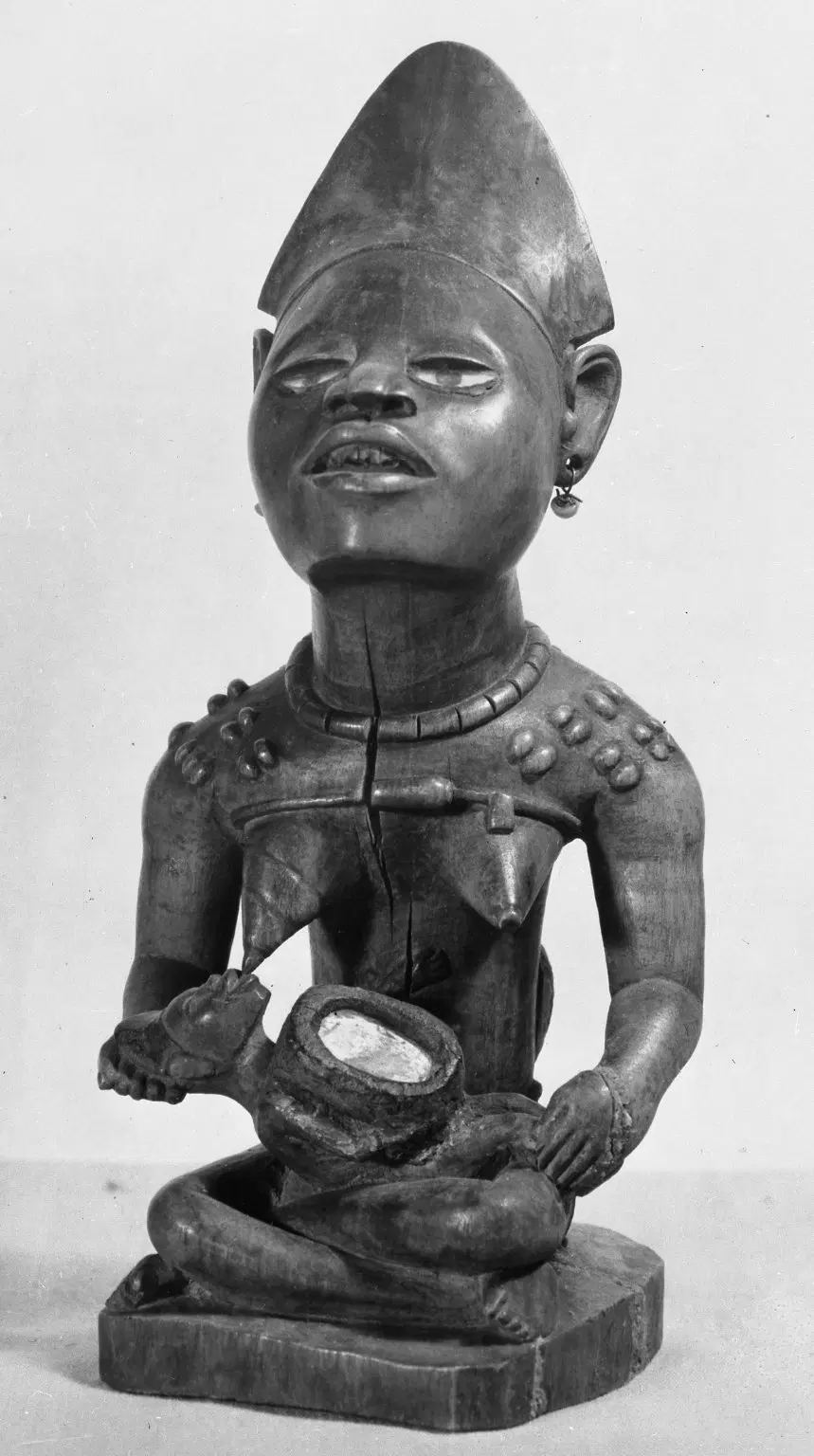
- Likely a commemorated noble or power figure to whom people prayed for blessings and fertility.
- Enlarged head symbolises wisdom; reduced body indicates hierarchy.
- Child on lap signals continuity; brass and head ornaments reinforce meaning.
Power Figures (Nkisi):
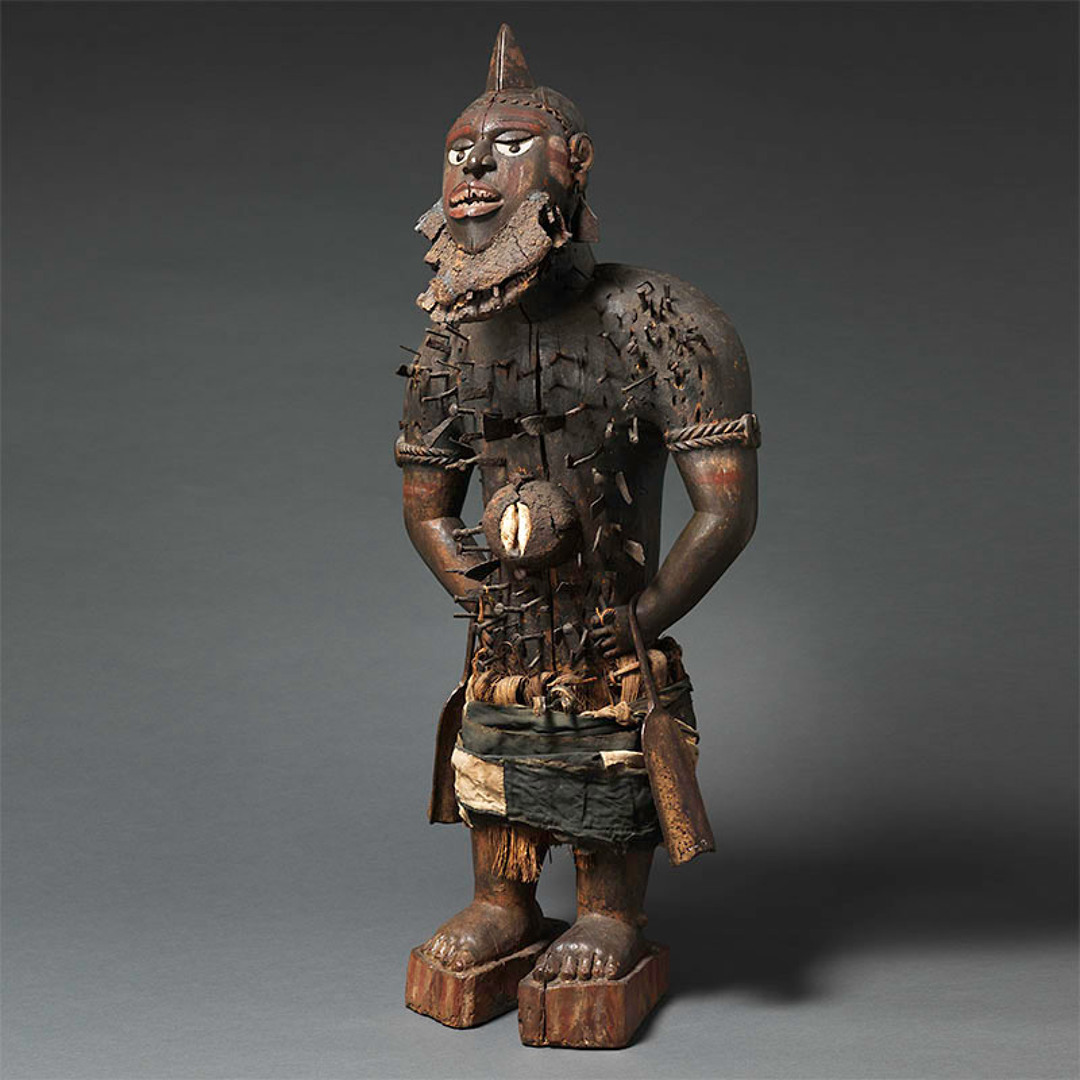
- Nkisi are wooden figures empowered by ritual specialists.
- Contain natural substances (herbs, minerals, animal parts) to attract and concentrate spiritual energy; horns from fierce animals may be added.
- Purposes include healing, protection, justice; some serve whole communities to promote well-being.
African Masks (General):
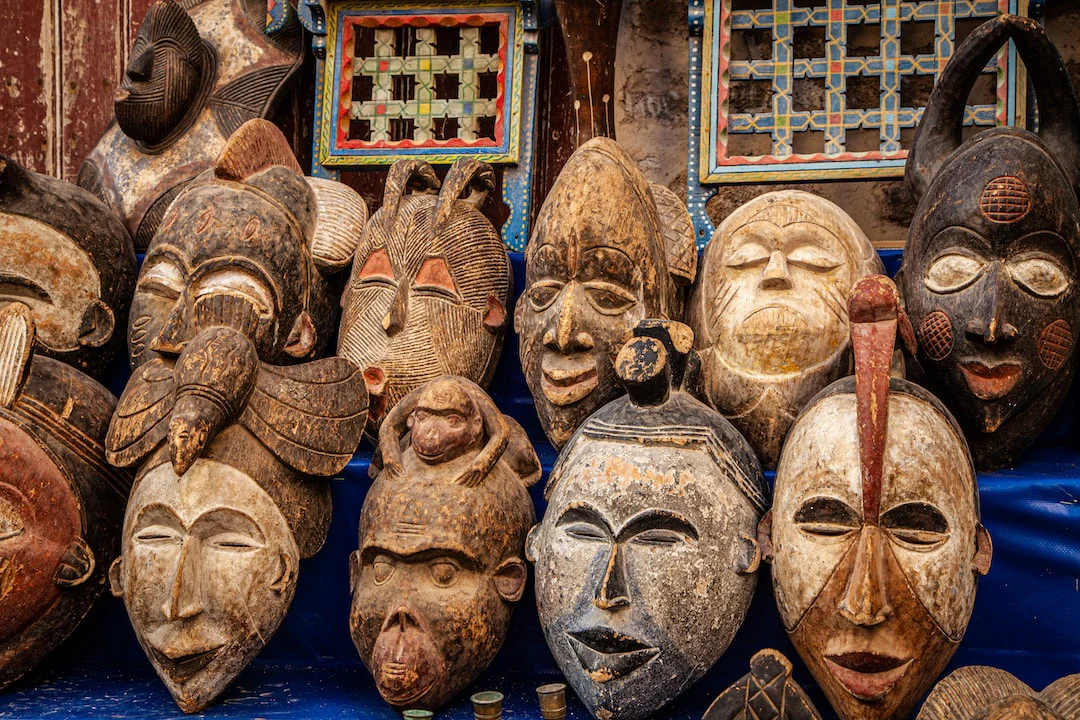
- Used in rituals, festivals, and secret societies to represent ancestors, spirits, or deities; the wearer embodies the being portrayed.
- Part of multi-sensory performances (sound, scent, dance, costume).
- Often carved from wood and adorned with engravings, oils, beads, shells, horns, and fibres.
Mboom Helmet Mask (19th c.):
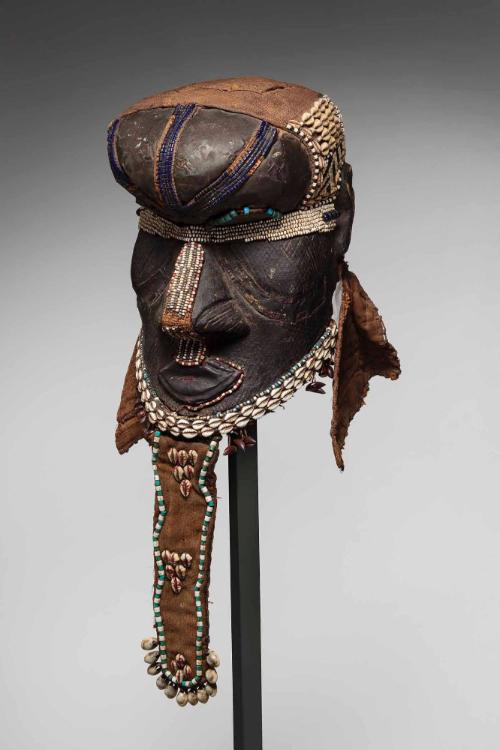
- Prominent forehead symbolises a primordial ancestor.
- Geometric patterning; shells and beads articulate nose and lips.
- Back fully decorated, forming a complete helmet structure.
D’Mba Mask:
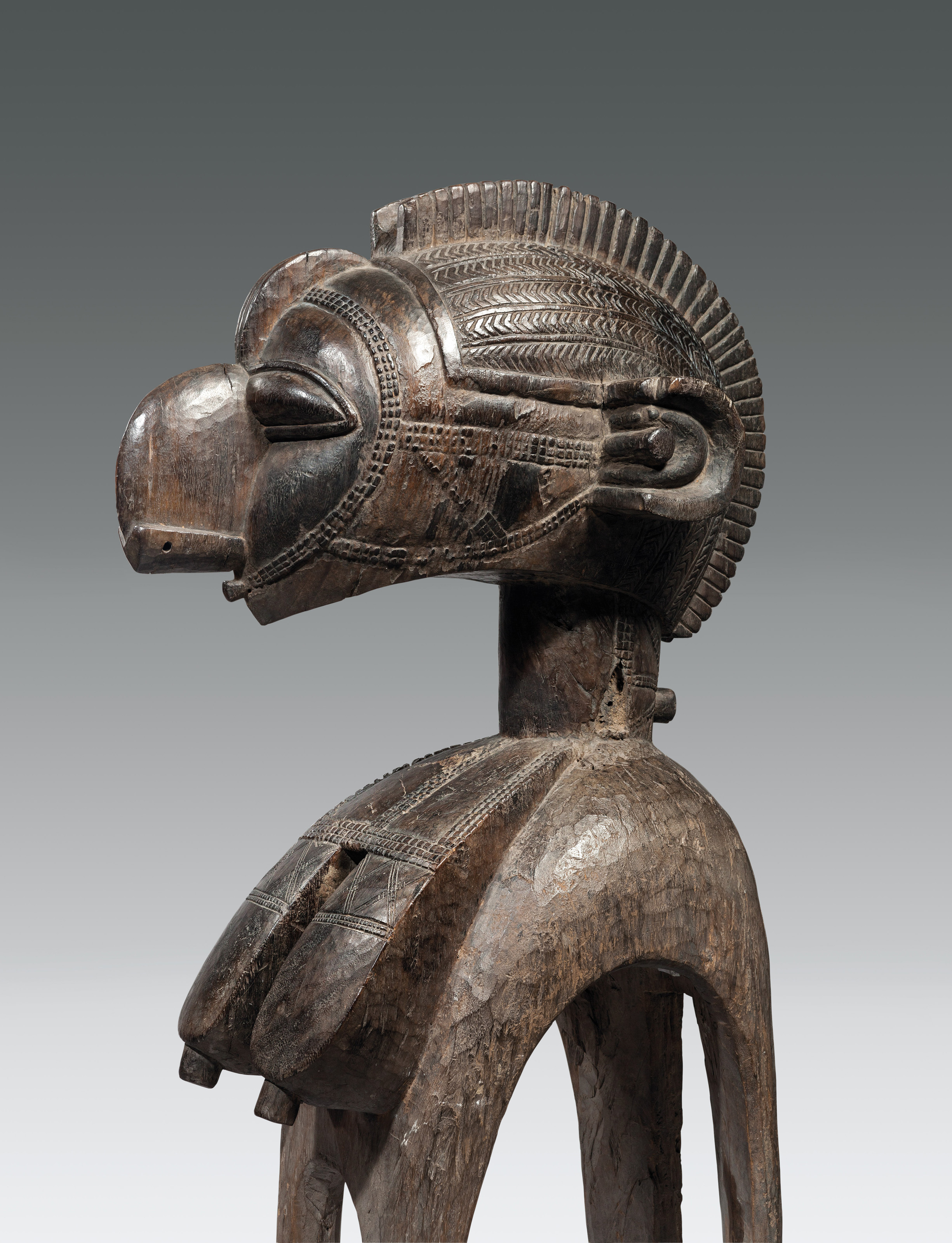
- Used in weddings and harvest ceremonies to honour women’s life-giving power.
- Large mask rests on dancer’s head and shoulders; supported by a framework and raffia costume emphasising the hips.
- Vision through two small holes between the breasts.
African Tribal Art Various makers
African Civilisations:
- Across thousands of years, African peoples produced diverse artworks, structures, and masks. Many early works did not survive because materials were perishable, and histories were preserved mainly through oral tradition.
- While Egypt is well known (treated separately), historians also identify many significant sub-Saharan civilisations across West, Central, and Southern Africa.
Key Civilisations & Timelines:
- Nok civilisation (near the Niger River): c. 500 BCE–2nd century CE; among the earliest known in West Africa.
- Ife: rises c. 11th century CE (European Middle Ages).
- Benin: flourishes c. 11th–16th centuries CE (contemporary with the European Renaissance).
- Central Africa (Congo River basin): dates still under study; ongoing archaeological discoveries.
- Southern Africa: artefacts like the Lydenburg Heads suggest established culture by the 6th century CE.
- Zimbabwe: advanced civilisation, c. 11th–16th centuries.
- Mapungubwe: prosperous community c. 1200–1300 CE.
Nok Terracotta Head (Nigeria):
- Among the oldest Nigerian sculptures; found near a grave and shrine, likely honouring ancestors.
- Stylised features: rounded hollows for eyes, triangular nasal opening; elaborate hairstyle likely represents plaited hair.
- Vents in nostrils and mouth aided the firing of the terracotta.
Ife Royal Head (Yoruba):
- Enlarged head signifies intelligence and leadership.
- Notably naturalistic compared with earlier geometric/abstract carving; rounded features and lifelike proportion.
- Ornate headpiece and jewellery symbolise royal power.
Benin: Head of the Queen Mother (16th c.):
- Cone-shaped headdress (woven/plaited hair), choker necklace, and fish motifs at the base reflecting customs.
- Calm, poised expression invites comparison with Renaissance realism.
Central Africa: Seated Woman (Congo Basin):
- Likely a commemorated noble or power figure to whom people prayed for blessings and fertility.
- Enlarged head symbolises wisdom; reduced body indicates hierarchy.
- Child on lap signals continuity; brass and head ornaments reinforce meaning.
Power Figures (Nkisi):
- Nkisi are wooden figures empowered by ritual specialists.
- Contain natural substances (herbs, minerals, animal parts) to attract and concentrate spiritual energy; horns from fierce animals may be added.
- Purposes include healing, protection, justice; some serve whole communities to promote well-being.
African Masks (General):
- Used in rituals, festivals, and secret societies to represent ancestors, spirits, or deities; the wearer embodies the being portrayed.
- Part of multi-sensory performances (sound, scent, dance, costume).
- Often carved from wood and adorned with engravings, oils, beads, shells, horns, and fibres.
Mboom Helmet Mask (19th c.):
- Prominent forehead symbolises a primordial ancestor.
- Geometric patterning; shells and beads articulate nose and lips.
- Back fully decorated, forming a complete helmet structure.
D’Mba Mask:
- Used in weddings and harvest ceremonies to honour women’s life-giving power.
- Large mask rests on dancer’s head and shoulders; supported by a framework and raffia costume emphasising the hips.
- Vision through two small holes between the breasts.
Global Connections Comparative Highlights
Snapshot: Place African works in dialogue with other pre-historic and non-Western masterpieces to underline common questions of origin, fertility, and monumentality.
Subject & Iconography: Compare the Venus of Willendorf's fertility coding with terracotta Nok figures, or align the Rapa Nui moai with the Djenne terracotta equestrians.
Planning Ideas: Use this space to drop research, timelines, or slide images that link African traditions to global peers for classroom discussion.