
Egyptian Art
The introduction highlights pyramids aligned to cosmic cycles, royal pairs like Menkaure and his queen carved for perpetual presence, and Nebamun’s painted banquets sustaining the afterlife—all visual pledges to uphold Ma'at.
Introduction
Ancient Egypt grew along the Nile, an “oasis” sustained by the river’s annual inundation and protected by surrounding deserts and the Mediterranean. This setting enabled stable agriculture, long dynastic continuity, and far-reaching trade. Deciphering hieroglyphs after the Rosetta Stone was found in 1799 and cracked in 1822 opened a clear window onto Egyptian religion, society, and art. At the summit stood the pharaoh, charged with maintaining cosmic order (Ma’at); writing, ritual, and image all served that order.
Key features of Egyptian art:
- Function first: Images and statues were made to serve gods and the dead—housing a presence (ka) and enabling ritual benefit—so forms are purposeful, durable, and often formally frontal.
- Stable conventions: Artists followed codified rules, such as a grid-based canon of proportions and composite views of the body, to express permanence, order, and ideality rather than fleeting appearance.
- Materials and continuity: Stone sculpture, painted relief, tomb goods, and inscriptions show remarkable consistency across Old, Middle, and New Kingdoms, even as styles shift.
Architecture: Egyptian building embodies clarity and monumentality in stone, using post-and-lintel systems laid out on axial plans. The pyramids monumentalised royal afterlife in the Old Kingdom, while later temple complexes—with pylons, courtyards, and hypostyle halls lit by clerestories—structured processions and worship as enduring expressions of cosmic order in built form.
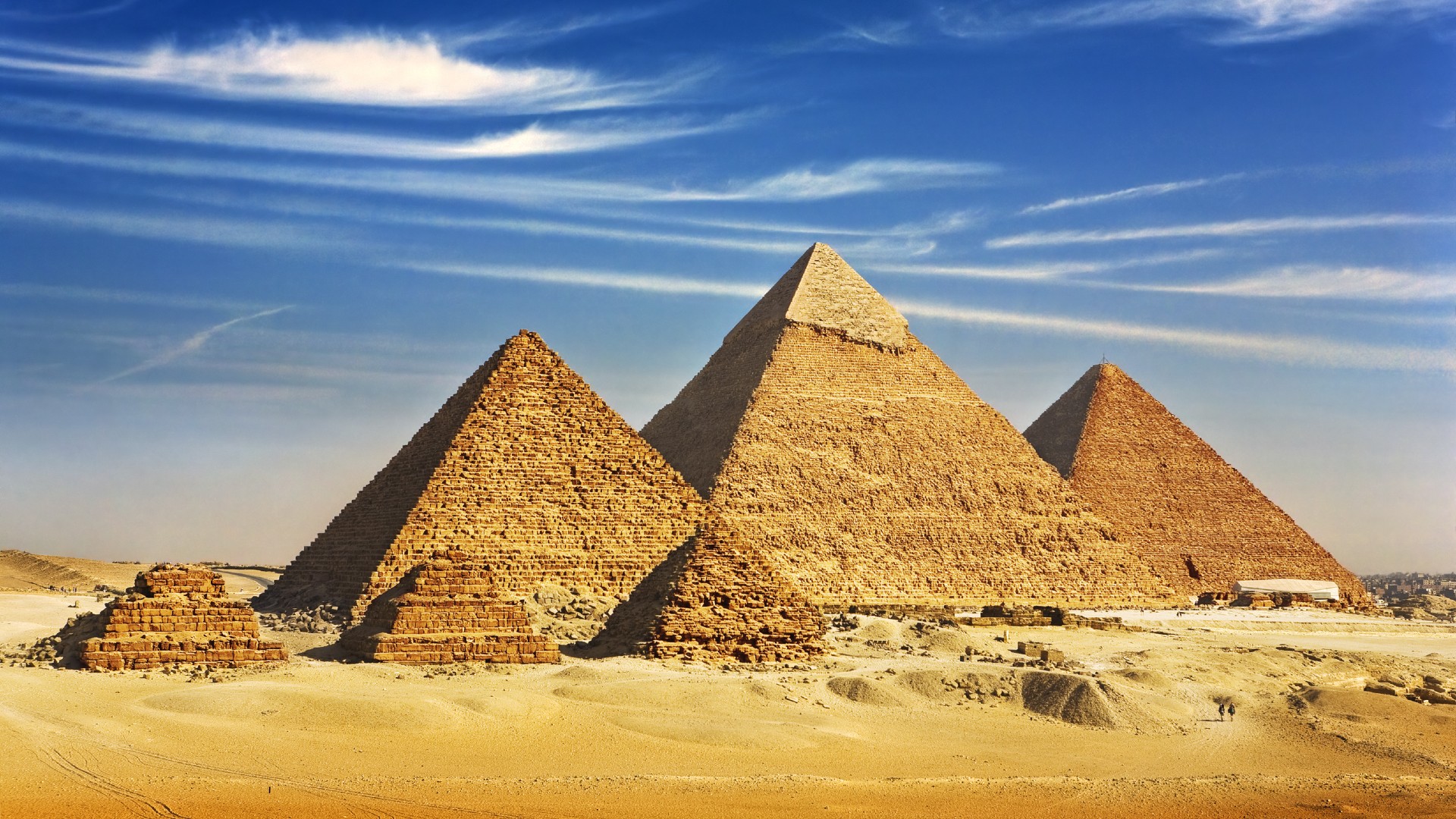
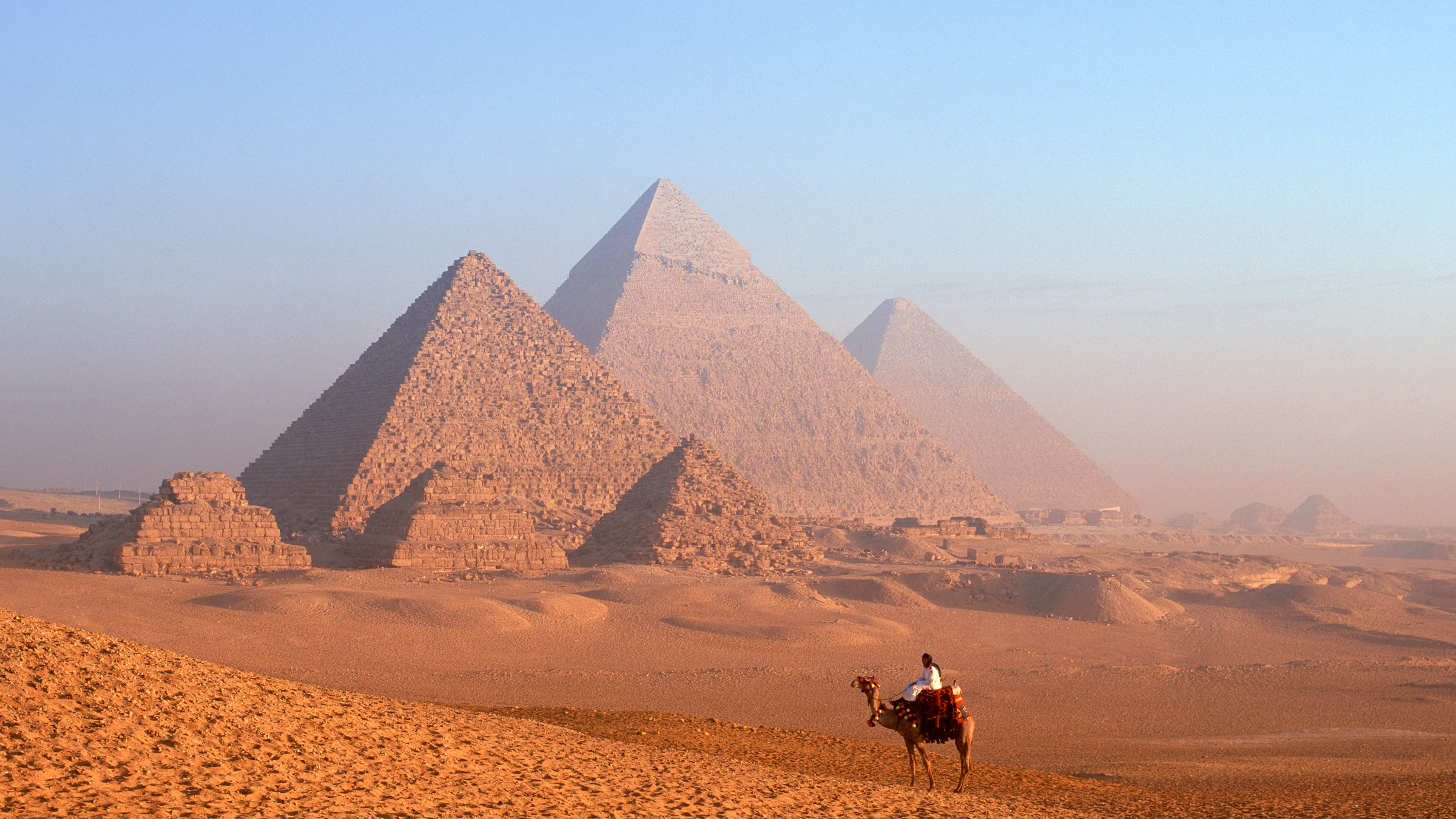
Pyramids of Giza Unknown
Snapshot:
- Monumental royal tombs for Khufu, Khafra, and Menkaura, guarding the mummified king and funerary treasures while declaring absolute pharaonic power.
- Pure geometric forms expressed Ma’at emerging from desert chaos and the divine king’s duty to sustain that order.
- Sited on the west bank of the Nile—the land of sunset and the dead—with causeways linking valley temples and mortuary temples aligned to the plateau.
- The Great Pyramid required roughly twenty years to complete, using an estimated 2.3 million blocks of limestone quarried and hauled by organised labour crews.
Subject & Iconography:
- Perfectly squared bases aligned to the cardinal points reinforce cosmic harmony; the north-facing entrance connects the king with circumpolar “imperishable” stars.
- Complexes include mortuary temples, satellite pyramids for queens, and boat pits containing solar barques for the pharaoh’s celestial journey.
- Causeways and valley temples formed ceremonial routes for the king’s body and for ongoing cult rites linking Nile floodplains to the elevated necropolis.
Formal Analysis:
- Triangular silhouettes originally sheathed in gleaming Tura limestone reflected intense sunlight, transforming the structures into radiant monuments.
- Massive core blocks laid in horizontal courses with relieving chambers above the burial vault demonstrate advanced engineering and weight distribution.
- True pyramid form evolved from earlier stepped mastabas, refining geometry toward smooth, unified planes that visually pierce the horizon.
Materials & Technique:
- Limestone core blocks with granite elements reinforcing internal chambers and relieving structures.
- Original casing carefully dressed to tight tolerances, likely polished to a mirror finish; capstones may have been gilded or sheathed in electrum.
- Construction organised through seasonal labour cadres, leveraging sledges, ramps, and copper tools hardened by arsenic for cutting softer stone.
Function & Context:
- Served as eternal residences for royal mummies, storing ritual goods, statues, and texts to sustain the king in the afterlife.
- Projected the ruler’s ability to marshal resources and ensure prosperity, reinforcing sacred kingship for the living populace.
- Landscape planning integrated worker villages, administrative quarters, and cemeteries for officials who participated in the funerary cult.
Style & Period Features:
- Embodies Old Kingdom emphasis on monumentality, geometry, and stone construction expressing permanence.
- Part of a larger necropolis including mastabas laid out on orthogonal grids, revealing precise surveying and planning techniques.
Interpretation:
- Pyramidal form symbolised the primordial mound rising from chaos and the sun’s rays, channeling the king’s ascent to the heavens.
- Aligned necropolis underscored royal control over cosmic cycles, ensuring Egypt’s fertility and stability.
Comparison:
- Earlier step pyramids such as Djoser’s at Saqqara illustrate transitional experimentation before the perfected Giza forms.
Condition/Changes:
- Most casing stones were quarried away in antiquity for later building; modern conservation stabilises remaining core blocks and surrounding structures.
King Menkaure and Queen Unknown
Snapshot:
- Royal dyad carved in hard greywacke: the pharaoh strides forward while the queen stands beside him in a supportive embrace.
- Frontal, upright, and balanced composition conveying unity, calm authority, and enduring strength.
- Originally painted and inlaid; faint traces of pigment survive on the flesh tones and headdress.
- Designed for the Valley Temple at Giza, exemplifying Old Kingdom royal portraiture.
Subject & Iconography:
- King wears the nemes headdress, false beard, and shendyt kilt; the queen’s sheath dress and embrace underscore shared divine status.
- Menkaure’s clenched fists grasp ritual cloths, signalling control and readiness for offerings; the queen’s arm across his torso echoes protective goddesses.
- The dyad embodies dual aspects of kingship: active rulership and nurturing support ensuring the king’s eternal vitality.
Formal Analysis:
- Blocky core shape anchors the pair to the back pillar and base, ensuring structural stability and formal clarity.
- Menkaure’s left leg advances in canonical pose while both figures maintain a vertical axis aligned with the statue’s central line.
- Subtle modelling in faces and torsos differentiates male and female physiques within tightly controlled geometry.
Materials & Technique:
- Greywacke was quarried upriver and transported to Giza, then carved with copper tools and abrasives before high polish.
- Back pillar retains carved guiding lines from the canon of proportions, visible where finishing halted.
Function & Context:
- Placed in the Valley Temple to host the pharaoh’s mortuary cult, receiving daily rites and sustenance for the king’s ka.
- Presented an ideal royal partnership reinforcing dynastic continuity and political stability in life and afterlife.
Style & Period Features:
- Adheres to Old Kingdom conventions: compact forms, bilateral symmetry, and interaction with a back pillar symbolising eternal support.
- Displays refined surface modelling achieved through laborious polishing, enhancing the statue’s luminosity under temple lighting.
Interpretation:
- Embodies royal partnership in life and eternity: the queen’s embrace activates the statue as a conduit for shared divine energy.
- Projected the king’s perpetual youth and strength, ensuring his authority extended into the afterlife.
Comparison:
- Contrast with Khafra’s diorite statue or the painted limestone couples Rahotep and Nofret to see shifts in material, intimacy, and status markers.
Condition/Changes:
- Original polychromy lost and base trimmed in antiquity; statue otherwise remarkably intact due to burial in the Valley Temple debris.
 and queen.jpg)
 and queen front.jpg)
Tomb of Nebamun Wall Paintings Unknown
Snapshot:
- Nebamun hunts birds from a papyrus skiff with his wife Hatshepsut behind him and their daughter between his legs.
- Portrays him eternally vigorous, surrounded by abundant wildlife rendered with exceptional colour and detail.
- Papyrus thickets teem with lotus blossoms, migratory birds, fish, and a domesticated cat adorned with gold jewellery pouncing on prey.
Subject & Iconography:
- Hieroglyphic captions proclaim Nebamun “enjoying himself and seeing beauty” in his estate.
- Marshes symbolise fertility and rebirth; the hunt enacts the triumph over chaos and renewal of life.
- The cat, an embodiment of Ra or Bastet, subdues darkness, while the lotus bouquet evokes regeneration.
Formal Analysis:
- Rich mineral pigments—Egyptian blue, malachite, and red ochre—define figures against the tawny plaster ground.
- Composite pose combines profile heads, frontal eyes, and torsos while wildlife receives carefully observed naturalistic touches.
- Diagonal throw-stick and swirling birds create rhythmic motion balanced by the stable grid of papyrus stalks.
Materials & Technique:
- Plaster laid over mudbrick walls, smoothed, and painted using fresco secco techniques with fine brushwork.
- Artists incised preliminary guidelines and grid lines before applying colour, ensuring adherence to the canon.
Function & Context:
- Decorated Nebamun’s tomb chapel to proclaim his wealth and secure eternal provisions through vivid ritual scenes.
- Imagery ensured the deceased could partake forever in hunting, feasting, and sensory pleasures within the Field of Reeds.
Style & Period Features:
- Retains New Kingdom canonical grid yet introduces lively overlapping flora and fauna for visual variety.
- Paired registers and framing bands integrate text and imagery, reflecting refined Theban tomb aesthetics.
Interpretation:
- Marsh-hunt proclaims Nebamun’s assured rebirth and endless delight in the afterlife, where he controls nature’s abundance.
- Solar and fertility symbols—lotus, cat, fish—affirm divine protection and cyclical renewal.
Comparison:
- Compare with the Papyrus of Ani or tombs of Nakht and Menna to see similar marsh scenes balancing canon and naturalism.
Condition/Changes:
- Fragments were hacked from the tomb walls in the early 1800s; edges remain irregular and some pigments faded, though conservation has stabilised the panels.
.jpg)
.jpg)