
Rococo Art
Fragonard’s The Swing and Watteau’s Pilgrimage to Cythera stage flirtation in perfumed gardens, the Salon de la Princesse wraps guests in gilt stucco and mirrors, and portraits of Madame de Pompadour broadcast wit, collecting, and fashionable taste.
Introduction
Characteristics
- Subject matter: Rococo was an art not for the general public, but for a frivolous aristocracy. The movement portrayed the life of the aristocracy and preferred themes of romance, mythology, fantasy and everyday life to historical or religious subject matter. It showed the aristocracy at play – a life of chamber music, dances, seduction and affected poses. Therefore, Rococo seems to be frivolous and sensual, without any weighty subject matter.
- Composition: Flowing, spiral-like and asymmetrical compositions. The compositions are full and figures and background form a unity.
- Shapes: Open, decorative, full of curls
- Colour: Primarily pastel colours
- Application: Clear brushstrokes
- Rococo art is frivolous and sensual, without weighty subject matter. Often with an artificial cuteness and ‘airy-fairy’ appearance. It is often a playful art – happy, superficial and decorative.
- During the Rococo portraiture was an important part of painting in all countries, but especially in Great Britain where Thomas Gainsborough reflected on the life of the rich landowners.
The Swing Jean-Honoré Fragonard
Snapshot: Playful garden scene where a young woman on a swing rushes toward her hidden lover while an older chaperone unknowingly propels her.
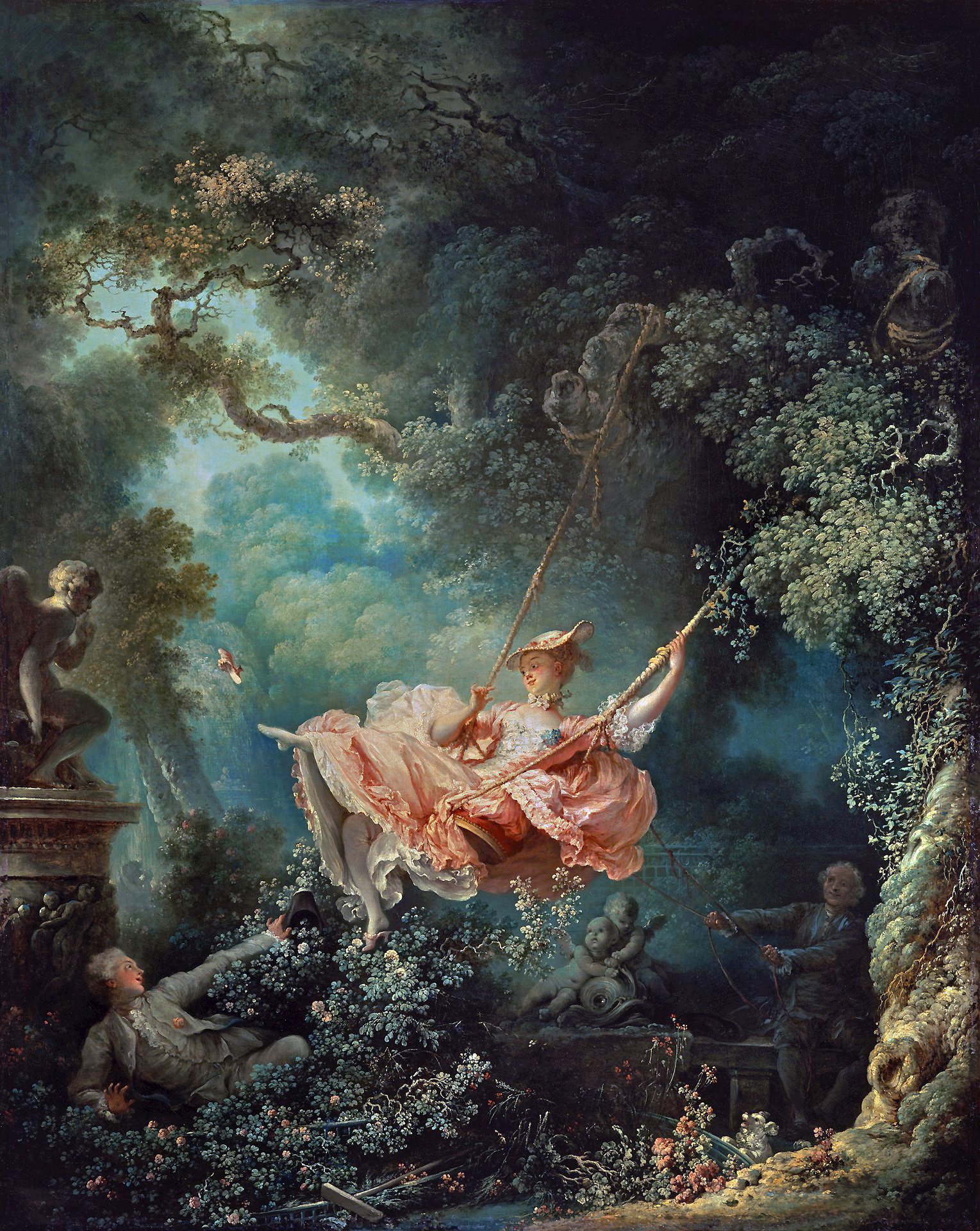
Subject & Iconography: Cupid statue urges secrecy, satin shoe flies, lush foliage frames a coded erotic rendezvous.
Formal Analysis: Curving S-lines, feathery brushwork, and pastel palette bathe the scene in theatrical light.
Materials & Technique: Loose, creamy oils with lively strokes and sparkling highlights on satin and leaves.
Function & Context: Commissioned for an aristocratic patron as a witty, private celebration of leisure and flirtation.
Style & Period Features: Showcases Rococo intimacy, arabesque forms, and playful moral ambiguity.
Interpretation: Satirizes elite frivolity and fleeting pleasure through coded erotic messaging.
Comparison: Contrast with Boucher’s pastoral fantasies or David’s later Neoclassical severity.
Condition/Changes: Well preserved following cleanings; retains luminous color.