Mesopotamian Art
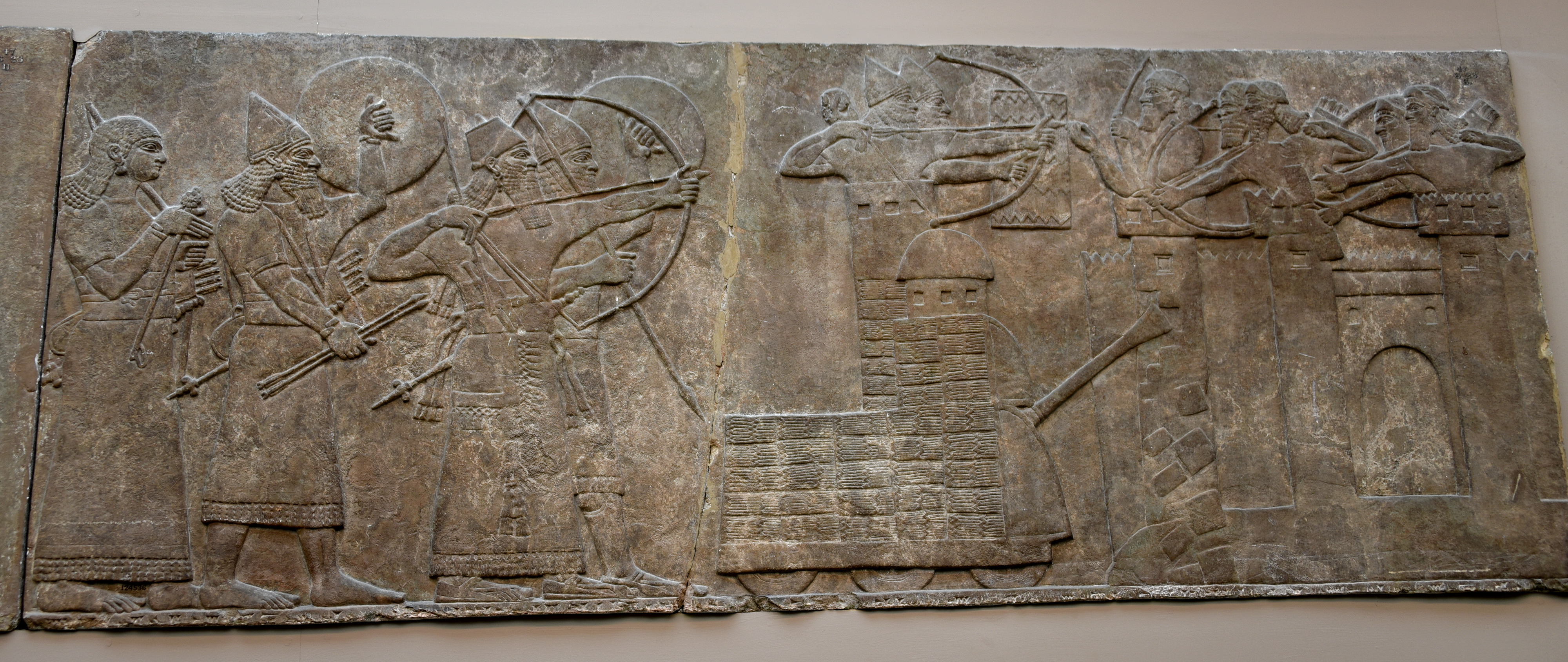
The introduction follows the Tell Asmar worshippers with wide inlaid eyes, the Standard of Ur war-and-peace registers, and Assyrian palace reliefs guarding ziggurat-centred temples—showing how art served gods, kings, and city identity.
Introduction
Ancient Mesopotamia (“land between the rivers”) refers to the region between the Tigris and Euphrates in today’s Iraq and surrounding areas. Here, early city-states formed, supported by irrigated agriculture, temple economies, and the invention of cuneiform writing, which preserved records, literature, and law. Over time, Sumerian, Akkadian, Babylonian, and Assyrian cultures shaped a shared visual language tied to worship, kingship, and urban life.
Key features of Mesopotamian art:
- Votive devotion and temple sculpture: Small standing figures with clasped hands and wide inlaid eyes (such as the Tell Asmar statues) embody perpetual prayer before the deity.
- Narrative registers and kingship: Composite scenes arranged in horizontal bands communicate order and hierarchy, as seen in the Standard of Ur with its contrasting “war” and “peace” panels.
- Royal ideology in palace reliefs: Monumental low-relief panels, especially in Assyrian palaces, show the king with protective spirits, in ritual, hunt, and war, often paired with repeating inscriptions.
Architecture: Mesopotamian cities centred on the ziggurat and temple complex—stepped mudbrick platforms crowned by a shrine that anchored religious, political, and ceremonial life, exemplified by the White Temple at Uruk and the Ziggurat of Ur.
Tell Asmar Worshipper Statues Unknown
Snapshot:
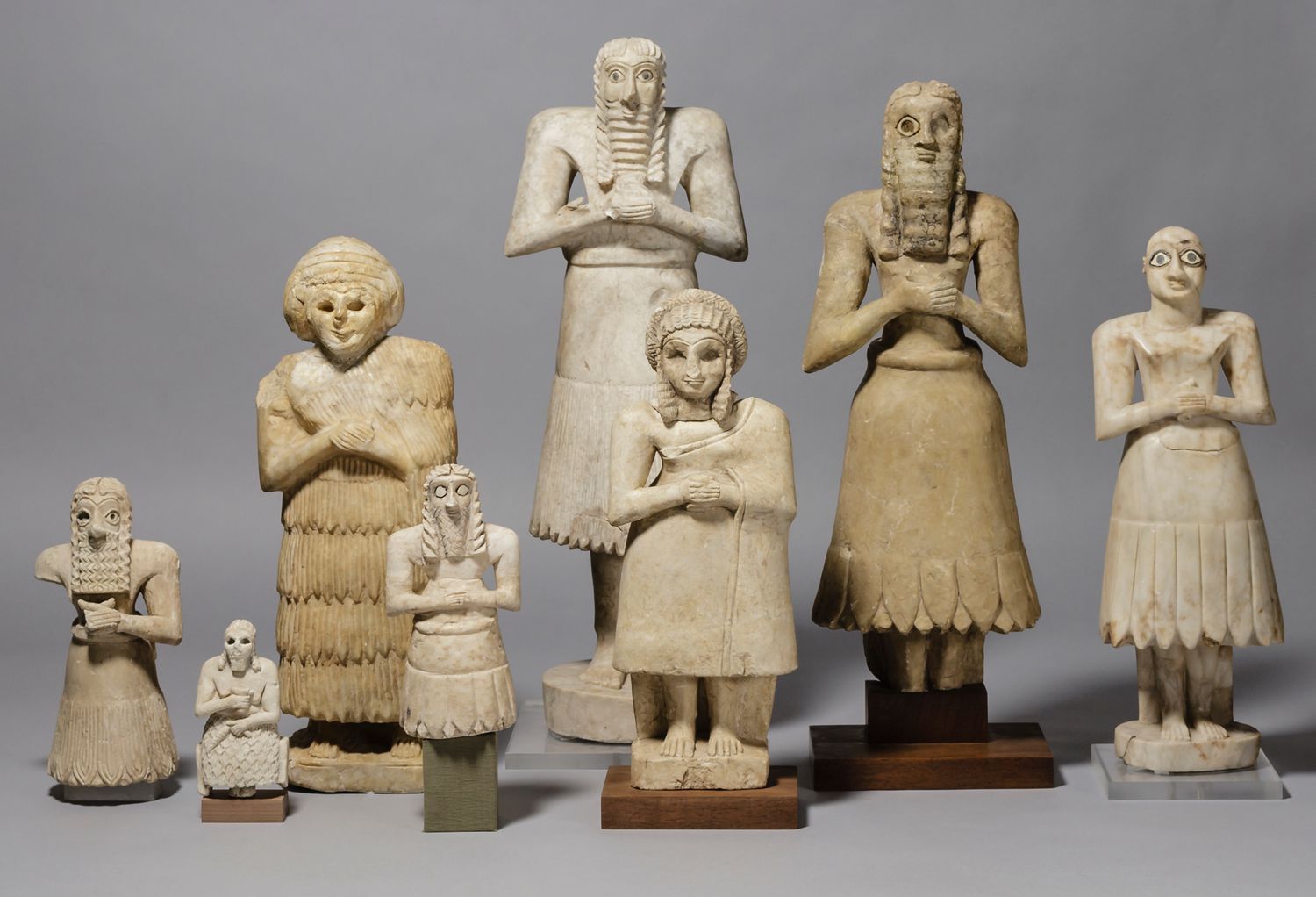
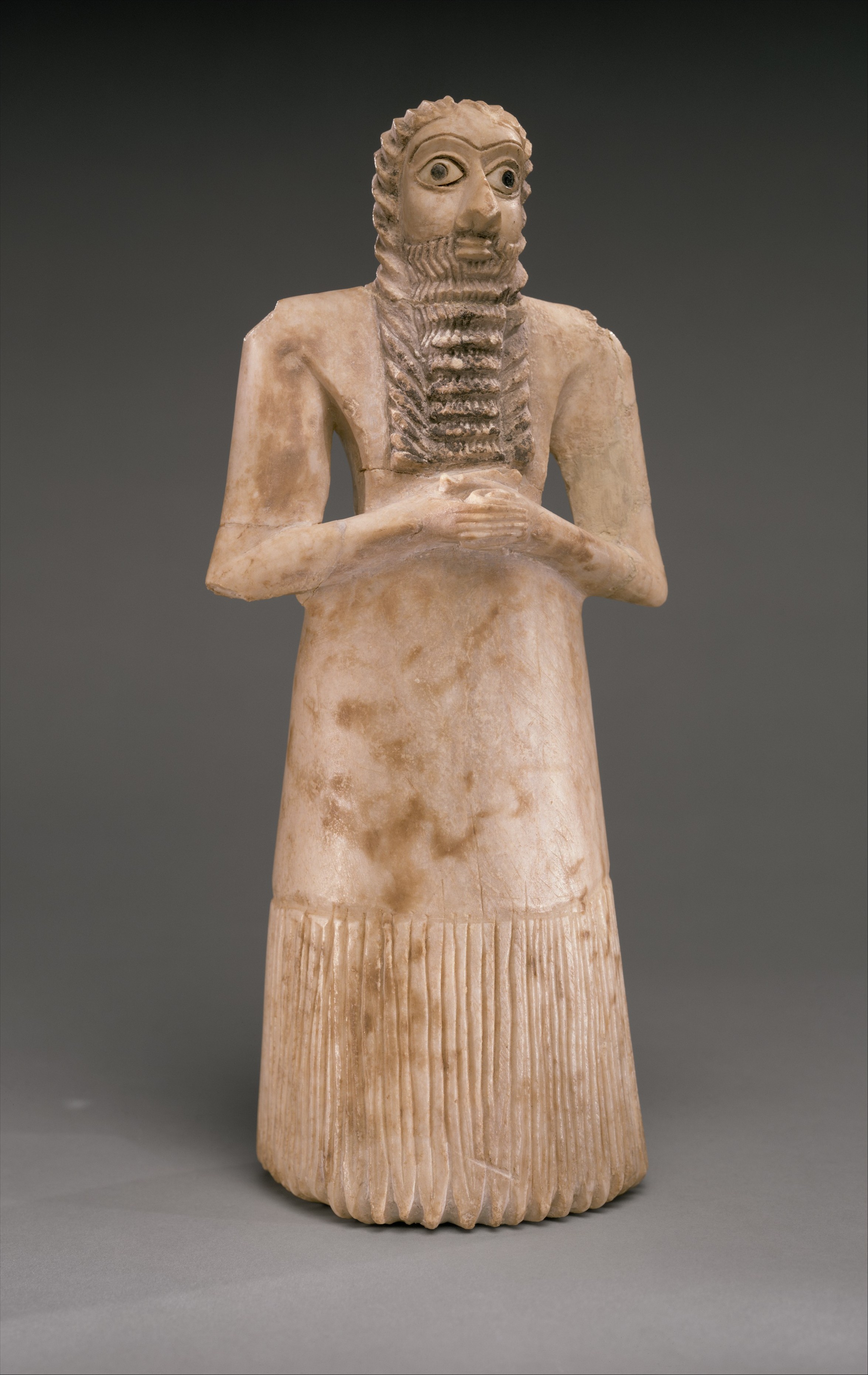
- Group of twelve standing figures with enlarged “goggle-eyes” and clasped hands, created as votive statues to honour the gods.
- Installed in the temple to offer continual prayer on behalf of their owners and community.
- Fashioned in the early Sumerian era and unearthed beneath the Square (Abu) Temple floor at Tell Asmar during 1934 excavations.
- Heights vary up to roughly 76 cm, signalling donor hierarchy.
Subject & Iconography:
- Tall male and slightly shorter female figures may reference divinities through emblems on their bases; larger companions read as priests, smaller ones as worshippers.
- All stand frontally with hands clasped against the torso and one foot subtly advanced.
- Gender distinction appears only in clothing: men bare-chested in fringed skirts, women in draped garments covering the left shoulder.
- Wide, staring eyes deliver an absorbed devotional gaze; facial variations stay within a stylised scheme.
Formal Analysis:
- Highly stylised conical and cylindrical volumes reduce anatomy to simplified forms.
- Head size is exaggerated while torsos act as supports for the vigilant faces.
- Frontal, motionless stance with repeating triangles in noses, beards, and arms generates rhythm.
- Patterned hair and beards; subtle facial differences appear within a standardised formula.
Materials & Technique:
- Gypsum (alabaster) carving, a soft Mesopotamian stone amenable to fine detail.
- Eyes inlaid with white shell and pupils of lapis lazuli or black limestone; brows likely filled with bitumen, which may also have coloured hair and beards.
- Height range includes a largest figure around 76 cm tall.
Function & Context:
- Dedicated in the Square/Abu Temple as votive surrogates to maintain perpetual prayer before the deity.
- Embodies Sumerian piety and social order, with scale corresponding to donor status.
- Several hold solid-footed goblets, linking them to libation offerings found near the sanctuary.
- Recovered together beneath the temple floor during the 1934 Tell Asmar excavation.
Style & Period Features:
- Typical early Mesopotamian frontality, geometric volumes, and outsized inlaid eyes signalling attention to the divine.
- Conventionalised clothing and patterned hair/beards with minimal anatomical description.
Interpretation:
- Figures embody humble, continuous devotion, keeping donors spiritually present before the deity.
- Enlarged eyes communicate vigilant watchfulness and focused prayer.
Comparison:
Condition/Changes:
- Cache was deliberately buried beneath the temple floor; most statues remain intact though some inlays and pigments are missing.
Standard of Ur Royal Cemetery of Ur
Snapshot:
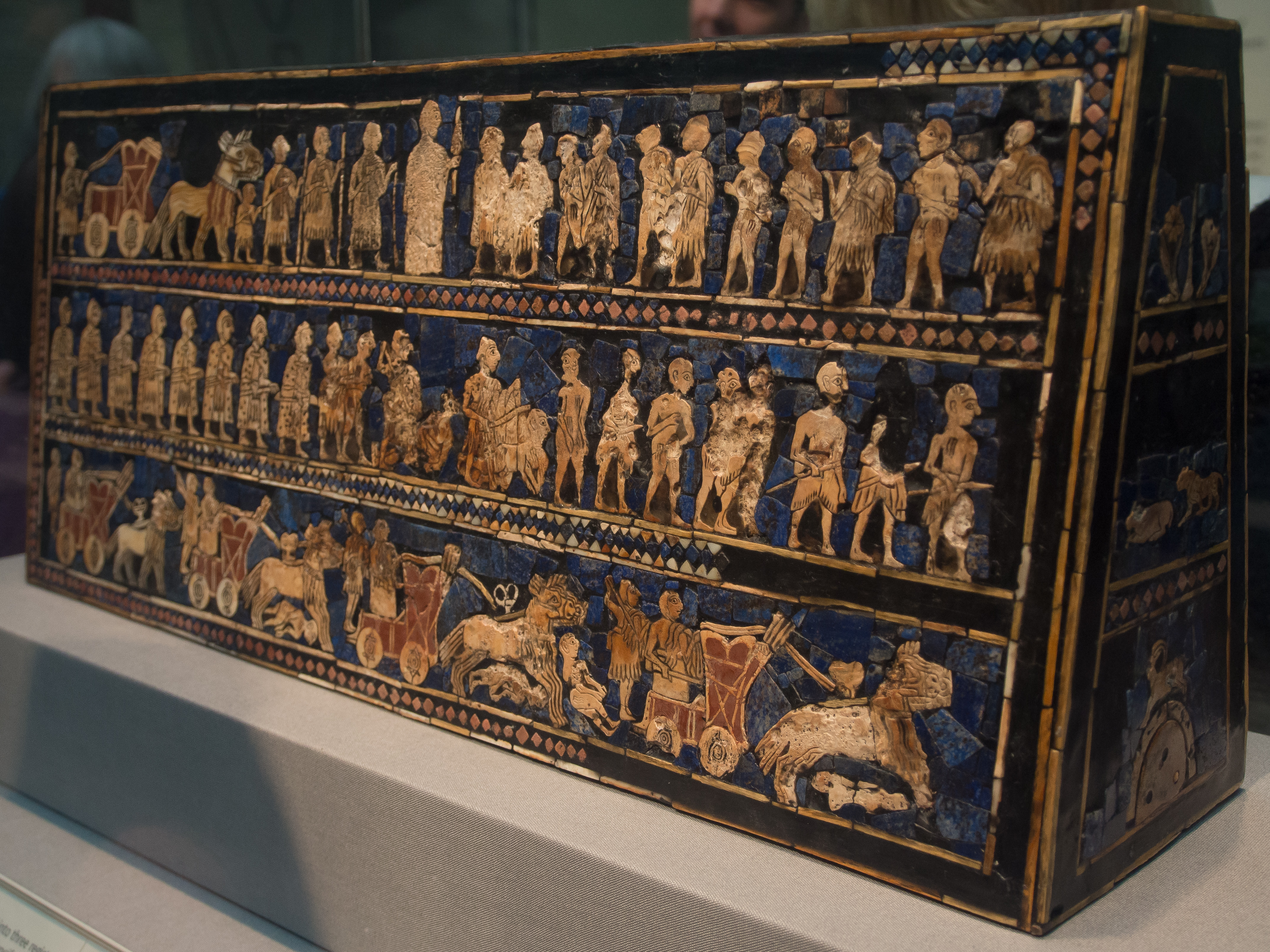
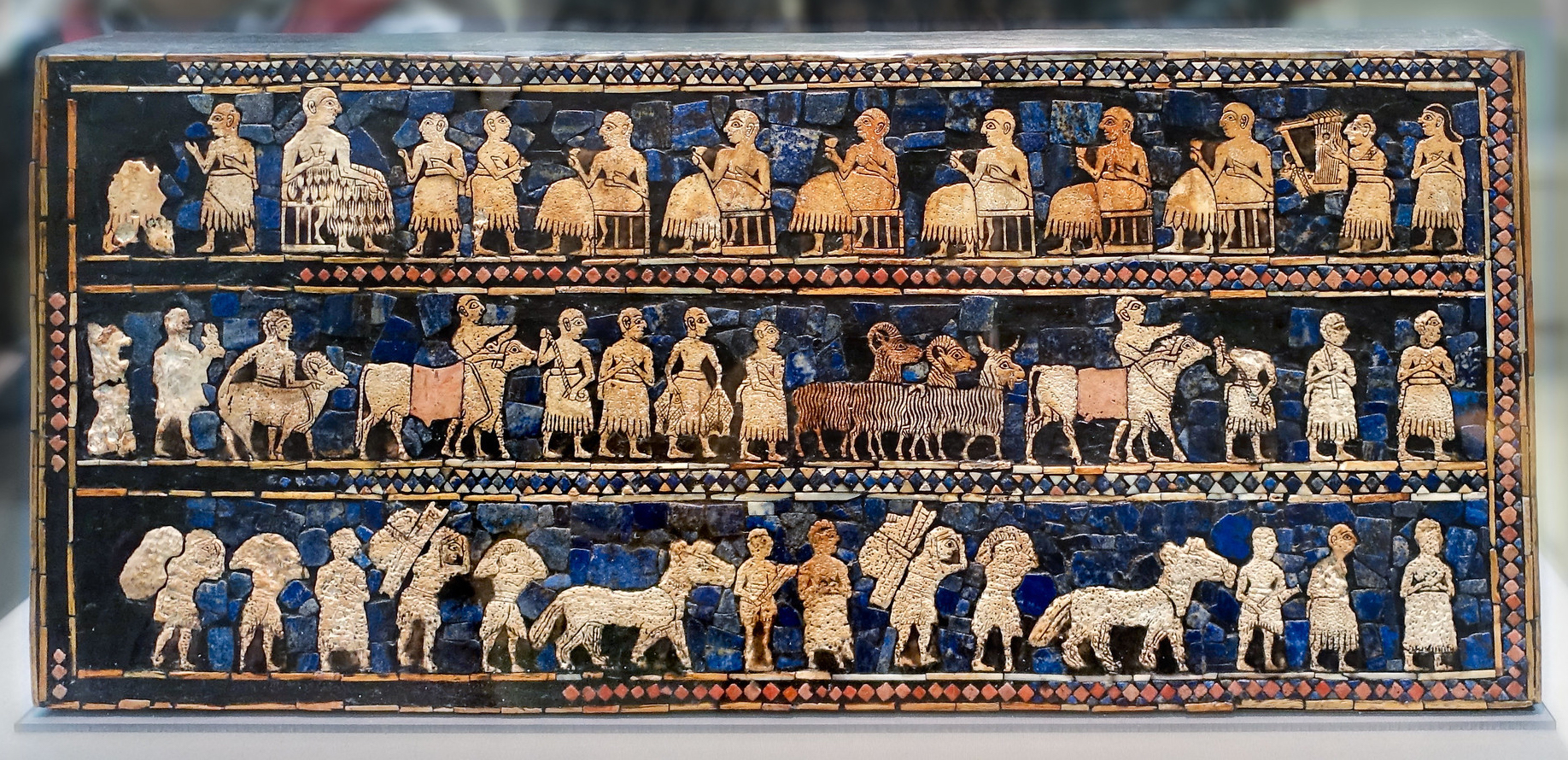
- Box-like object with two large mosaic panels titled “War” and “Peace,” each divided into three rows telling a continuous story—an early example of narrative art.
- Excavated in a presumed royal burial at Ur; found near a man's right shoulder.
- Materials and craftsmanship (shell, lapis lazuli, red limestone set in bitumen) signal an organised, prosperous community engaged in long-distance trade.
- Object is unusual in form (two large panels plus triangular end pieces); purpose remains uncertain after reconstruction.
Subject & Iconography:
- “Peace” side: lower rows show people bringing offerings (fish, sheep, oxen); upper row shows the king, attendants, and musicians feasting.
- The king is the largest figure and breaks the border (hierarchic scale), while smaller land workers indicate lower status.
- “War” side: commanders and soldiers in full-length robes defeat naked, humiliated prisoners; chariots trample bodies as captives are marched away.
Formal Analysis:
- Three stacked registers create clear, continuous narration.
- Figures mostly appear in profile within an organised pictorial space; side-by-side arrangement suggests teamwork, as in the paired charioteers.
- Repetition of figures conveys large numbers, while simplified shapes ensure clarity and order.
- Movement unfolds in stages (donkeys walking, trotting, galloping) to suggest action.
Materials & Technique:
- Inlaid shell (from the Gulf), lapis lazuli, and red limestone (from India) set into locally sourced bitumen and mounted in wooden frames.
- Two large panels with triangular end pieces; fine mosaic inlay indicates skilled artisans and organised production.
Function & Context:
- Found in a royal burial; once interpreted as a processional “standard,” now considered a box of unknown function.
- “Peace” imagery reveals social hierarchy arising from agricultural surplus and priestly/warrior elites.
- “War” imagery underscores the violence and control underpinning early urban civilisation.
Style & Period Features:
- Early Mesopotamian narrative art with ordered registers and readable action.
- Hierarchic scale clarifies rank; class distinctions emerge through size and placement.
- Profile figures, rhythmic repetition, and staged motion act as diagnostic traits.
Interpretation:
- Dual message of rulership: warfare secures victory, while peace brings prosperity under the king's authority.
- The panels act as social documents recording surplus economy, stratification, and state power.
Condition/Changes:
- Reconstructed from fragments; triangular end pieces and the misnomer “standard” show how understanding of its form and function has evolved.
Reliefs from the Palace of Ashurnasirpal II Unknown
Snapshot:
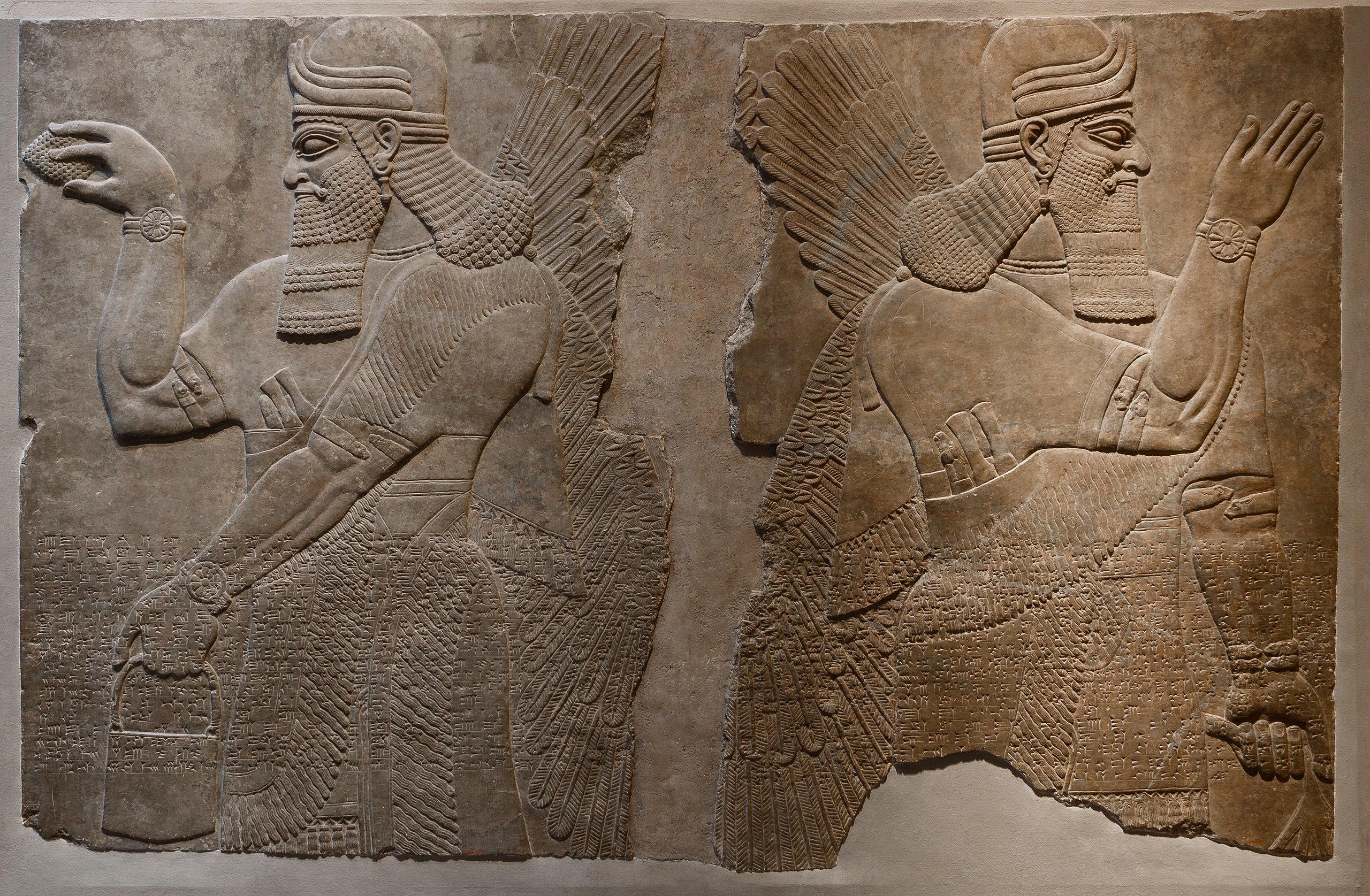
- Large gypsum-alabaster wall reliefs from Ashurnasirpal II’s palace at Nimrud projecting his physical, spiritual, and political power.
- Installed in high-profile palace spaces on orthostat blocks about 3 m tall to impress entrants.
- Imagery spans battles, hunts, and rituals rendered in purposeful, simplified style to emphasise strength and authority.
Subject & Iconography:
- Throne room panels show the king twice flanking a stylised Sacred Tree while protective spirits (apkallu) bless him with cone and bucket.
- Royal robes, mace, and the divine ring communicate authority granted by the gods.
- Winged disk (Ashur or Shamash) hovers above as the king raises his hand in worship.
- War scenes with chariots and ranked troops, plus lion hunts, dramatise the subduing of enemies and chaos.
Formal Analysis:
- Composite conventions pair profile heads and frontal eyes with shoulders shown in combined views.
- Patterned hair, beards, and garments deliver rhythmic surface detail; proportions exaggerate royal presence.
- Overlapping ranks and an advanced foot introduce emphasis and implied motion.
Materials & Technique:
- Gypsum-alabaster orthostats carved in low relief and set along palace walls; heights typically near 3 m (example panels c. 178 cm).
- Durable stone permitted fine linear carving and expansive narrative programs across rooms.
Function & Context:
- Architectural decoration asserting royal authority and divine favour within ceremonial settings.
- Recorded conquests, hunts, and rituals to affirm the king as guarantor of order and prosperity.
Style & Period Features:
- Ninth-century Assyrian idiom favouring deliberate simplification over naturalism with rich patterning.
- Composite views and ordered registers deliver legible narratives.
- Recurring sacred motifs—winged disk, Sacred Tree, blessing genies—link religion and kingship.
Interpretation:
- Presents the king as invincible conqueror and divinely chosen ruler.
- Ritual imagery and lion hunts symbolise cosmic order, fertility, and the taming of chaos through royal courage.
Comparison:
- Shares Mesopotamian conventions (profile heads with frontal eyes, regimented storytelling) but scales them for imperial propaganda unlike the Standard of Ur.
Condition/Changes: