
Pre-Historic / Non-Western Art
Pre-historic and other non-Western traditions share a focus on ritual, ancestral memory, and cosmology; use this page to trace recurring motifs that echo through later civilizations.
Venus of Willendorf Unknown
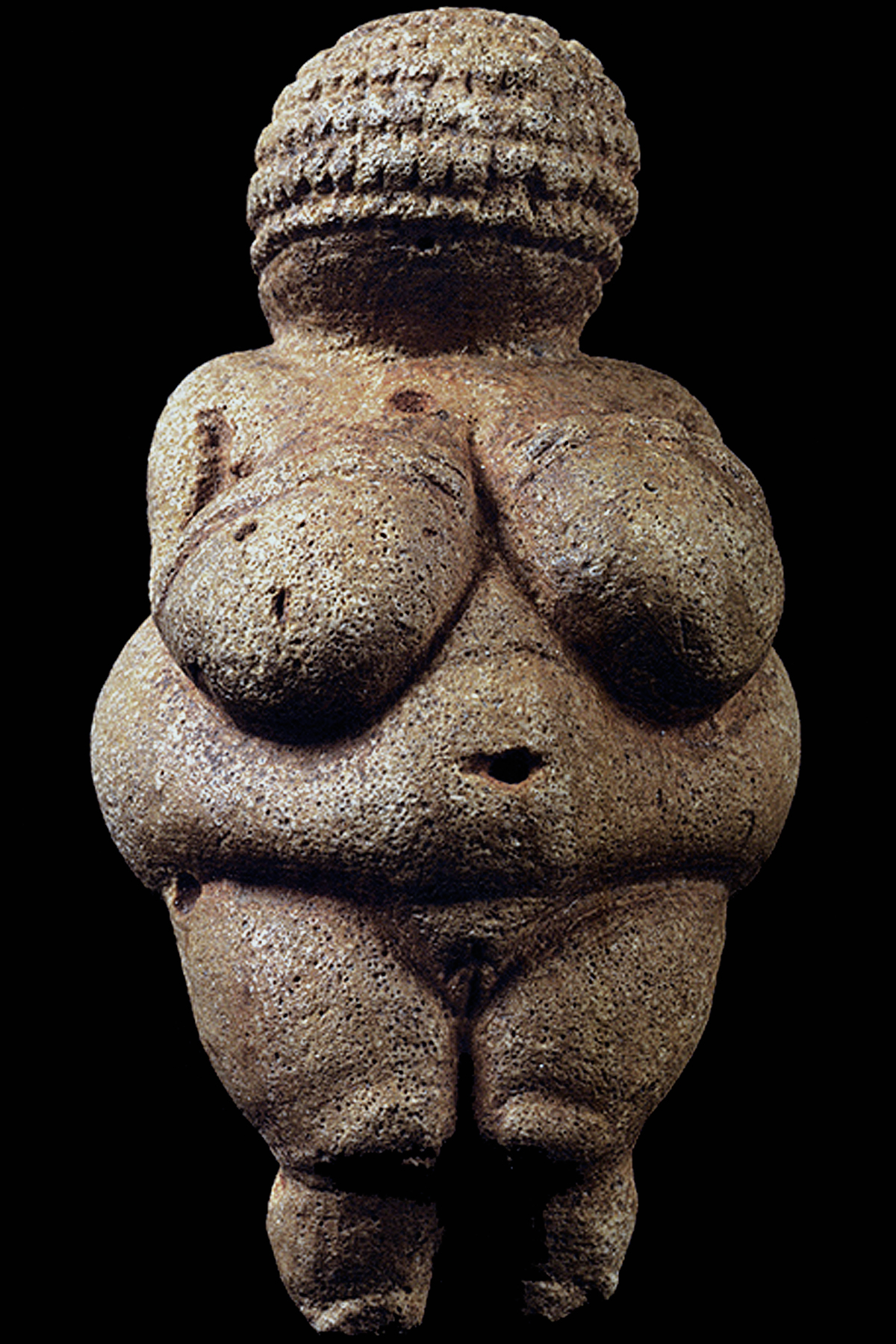
Snapshot:
- Tiny handheld stone carving (~11.5 cm) from Austria, celebrated as one of the earliest surviving human likenesses.
- Compact, rounded volume sized to fit the palm; a Paleolithic portable object.
- Fertility and reproduction signalled through enlarged belly, thighs, and breasts.
Subject & Iconography:
- Exaggerated abdomen, thighs, and breasts foreground reproductive abundance while personal identity is suppressed.
- Faceless head wrapped with patterned bands that may indicate braided hair or a woven cap.
- Arms reduced to slight bands across the torso and no feet, focusing attention on life-bearing features.
- Incised bracelets and navel detailing hint at adornment despite minimal anatomy.
Formal Analysis:
- Spherical, rounded masses strengthen tactile presence and encourage handling.
- Compact, symmetrical silhouette concentrates attention on the torso and reproductive features.
- Minimal facial and limb detail underscores symbolic emphasis over portrait likeness.
Materials & Technique:
- Oolitic limestone carved with stone tools and stained using red ochre.
Function & Context:
- Often interpreted as a votive or teaching aid linked to fertility, pregnancy, or abundance rituals.
- Childbirth-related features purposefully magnified; individual identity deemphasised in favour of communal ideals.
- Discovered 7 August 1908 at a Paleolithic site near Willendorf, Lower Austria by excavators Szombathy, Obermaier, and Bayer.
Style & Period Features:
- Typical of Paleolithic portable sculpture: exaggeration outweighs realism, anonymity outweighs portraiture, and scale remains small for transport.
Interpretation:
- Viewed as a fertility or abundance charm tied to reproduction and the community’s need for new members.
- Alternate readings connect the figurine to Gravettian ritual aesthetics or self-representation of pregnant women.
Comparison:
- Compare with other Venus figurines (Lespugue or Dolní Vestonice) to note regional differences in scale and stylisation.
Condition/Changes:
- Surface shows minor abrasion from burial; ochre pigment survives in recesses around the breasts and abdomen.
.png)
Easter Island Stone Heads Unknown
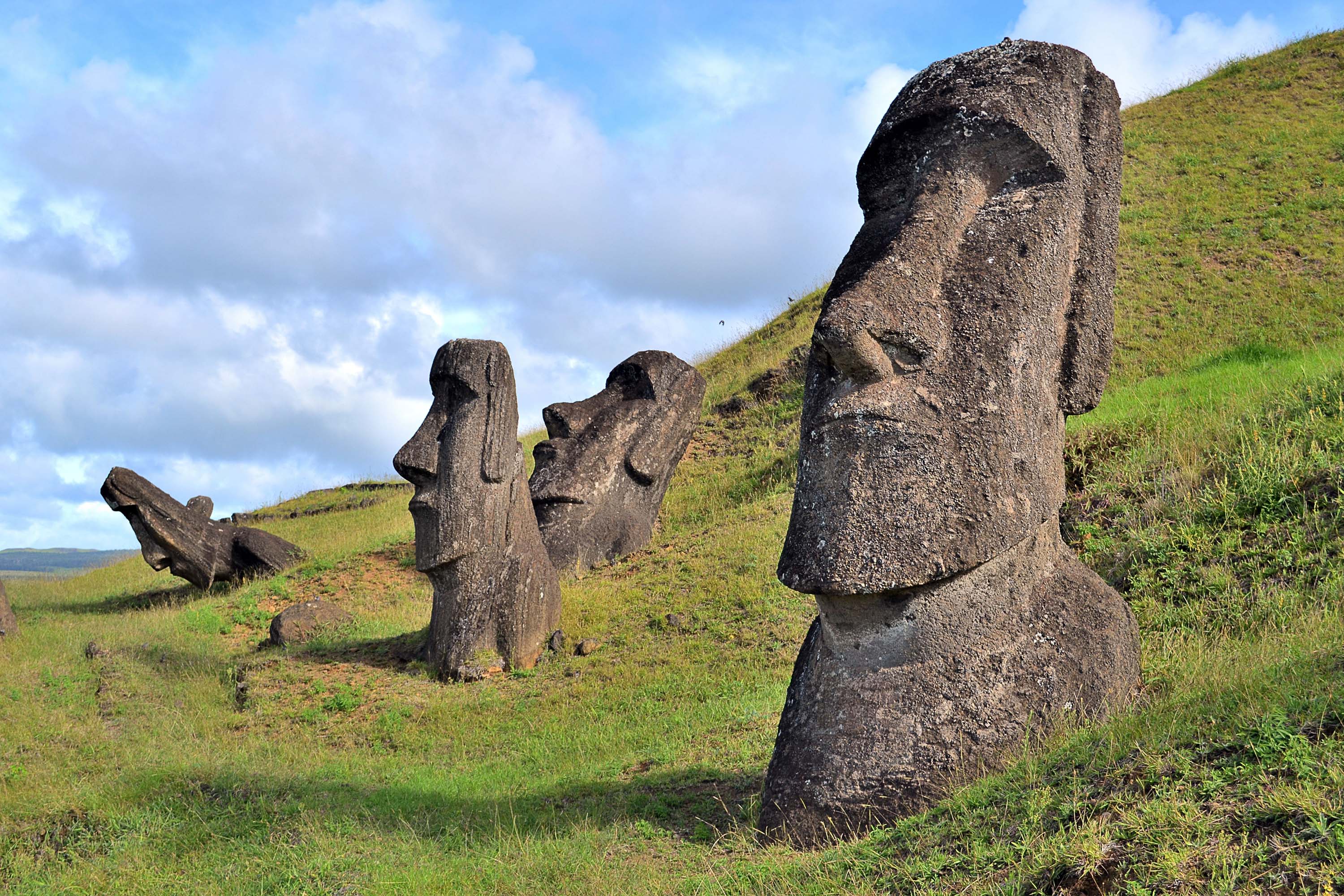
Snapshot:
- Rapa Nui communities carved nearly 1,000 moai statues over five centuries.
- Monuments line ceremonial ahu platforms, most facing inland to watch over ancestral lands.
- European navigator Jacob Roggeveen encountered the statues in 1722, inspiring the island’s colonial name “Easter Island.”
- Carving slowed and toppled statues after late 17th-century social upheavals, slave raids, and ecological stress.
Subject & Iconography:
- Monumental moai heads with elongated faces, long ears, strong jaws, and prominent noses and chins.
- Inland orientation symbolically oversees the community and ancestral territories, channelling protective mana.
- Some retain coral-and-obsidian eye inserts or red pukao topknots that denote chiefly status.
Formal Analysis:
- Colossal scale paired with elongated proportions and emphatic jaw-nose profiles carved in low relief.
- Repetition of a consistent facial schema across numerous statues establishes visual unity while subtle variations mark clan identity.
- Predominantly upright, self-contained masses generate a commanding rhythm encircling the ceremonial landscape.
Materials & Technique:
- Figures carved from volcanic tuff at Rano Raraku using basalt adzes and chisels.
- Many were topped with red scoria pukao and fitted with coral-and-obsidian eyes during installation.
- Hundreds of unfinished moai remain in the quarry, including giants nearly 10 metres long and weighing up to 270 tons.
Function & Context:
- Polynesian voyagers settled Rapa Nui by c. 1200 CE, organising clans around ahu platforms aligned with lineage lands.
- Inland-facing moai embody ancestral guardianship, watching over fields, fishing grounds, and the living community.
- Carving largely ceased after late 17th-century conflicts, ecological strain, and slave raids toppled many statues.
- Rongo rongo boards hint at ceremonial chants that may once animated the moai.
Style & Period Features:
- Polynesian monumental carving emphasizes elongated facial features, long ears, and compact torsos rising from the base.
- Moai were installed on stone ahu and consistently oriented inland, forming a distinctive site convention.
- Cohesive, stylised forms link individual statues into a unified cultural landscape resonating with clan narratives.
Interpretation:
- Precise meanings were disrupted by colonial upheaval, but the inward gaze and status-marking eyes imply guardianship and chiefly leadership.
- Moai channel ancestral mana, reinforcing communal identity and stewardship of land and sea.
Comparison:
- Compare with other Polynesian stone figures to explore shared ancestral veneration across Oceania.
Condition/Changes:
- Hundreds of moai remain unfinished or toppled at Rano Raraku; 20th-century restorations have re-erected selected statues on ahu.
- Weathering, lichen growth, and past loss of coral eyes pose ongoing conservation challenges.
.jpg)