
Roman Art
The introduction traces Republican verism, Augustan propaganda, and concrete arches and domes; Augustus of Prima Porta, the Ara Pacis, the Colosseum, and the Pantheon show how imagery, relief, and vast spatial design proclaimed Roman order.
Introduction
Roman art developed out of Etruscan roots and a deep admiration for Greek (especially Hellenistic) models, but it became distinctly Roman in purpose and scale. Romans organised images and buildings to serve the state, celebrate leaders, honour ancestors, and structure civic life—combining borrowed styles with their own engineering and administrative strengths. From the Republic into the Empire, art and architecture worked as public messaging, commemoration, and urban infrastructure all at once.
Key features of Roman art:
- Portraiture and verism: Highly lifelike portraits—especially in the Republic—emphasised age, experience, and civic virtue (“warts and all”), before later imperial idealisation.
- Imperial imagery and propaganda: Official portraits, monuments, and reliefs (e.g., Augustan programs) communicated authority, legitimacy, and shared values across the Empire.
- Engineering and scale: Mastery of the arch, vault, and dome, enabled by concrete, produced vast interior spaces and durable public works (aqueducts, amphitheatres, roads, baths).
- Painting and domestic decoration: Wall paintings and mosaics adorned homes and villas; at Pompeii, four major wall-painting styles are recognised.
- Adaptation of Greek art: Many works copied or reinterpreted Greek originals, but Roman uses were practical—political, commemorative, and domestic.
Architecture: Roman architecture aimed for clarity, order, and usefulness in the city. Builders used a common language of column and entablature while expanding possibilities with concrete and curved forms. The Pantheon epitomises Roman spatial ambition—its coffered concrete dome and columned porch join structural innovation with classical appearance. Typical public buildings included basilicas, baths, amphitheatres, forums, and triumphal arches. Roman designers also adapted and extended the Greek orders: Doric, Ionic, and Corinthian, alongside Tuscan (a simplified Doric) and Composite (a late combination of Ionic volutes and Corinthian acanthus).
Augustus of Prima Porta Unknown
Snapshot:
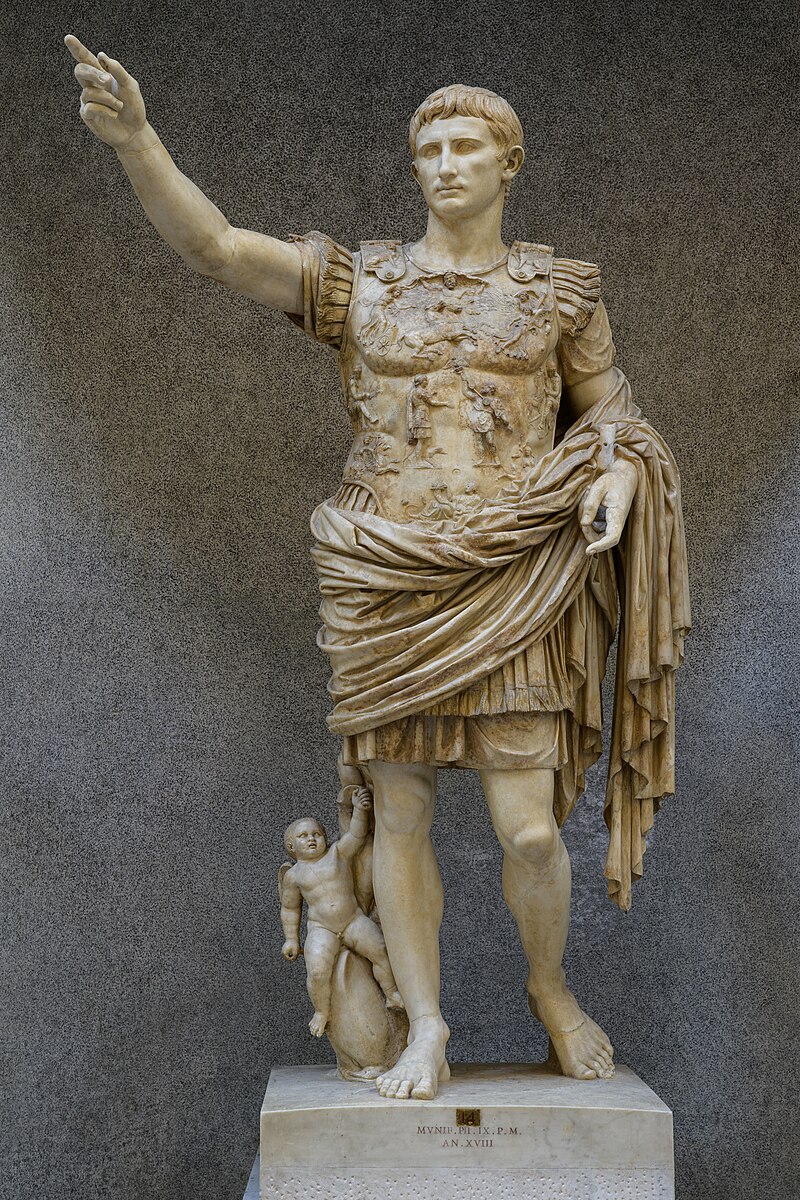
- Idealised, ageless portrait of Augustus as calm commander in adlocutio, blending Greek Classical form with Roman political messaging.
- Program on the cuirass commemorates the Parthian return of Roman standards (20 BCE), framing Augustus as guarantor of peace and order.
- Found in 1863 at Livia’s villa at Prima Porta; now in the Vatican Museums (Braccio Nuovo).
- Over-life-size (c. 2.03 m) marble copy; the original was likely bronze and polychromed.
Subject & Iconography:
- Raised right hand (adlocutio) and military cloak (paludamentum) present Augustus addressing troops and asserting authority.
- Cuirass centre: Parthian returns legionary standards to Rome after Carrhae; flanking figures and provinces affirm imperial reach.
- Upper zone: Caelus/Heavens with Sol and Aurora (sun/dawn) signal cosmic sanction; sides include Apollo and Diana. Lower: Tellus/Earth with infants and cornucopia (fertility, prosperity).
- Cupid on a dolphin at the right leg proclaims Julian descent from Venus and alludes to the naval victory at Actium.
- Bare feet connote heroic/divine status beyond ordinary mortals.
Formal Analysis:
- Contrapposto and ideal proportions recall Polykleitos’ Doryphoros, appropriated to imperial portraiture.
- Youthful, perfected visage replaces Republican verism—calm control over emotion and body.
- Composed relief scheme integrates narrative to torso architecture, keeping symmetry and legibility.
- Roman dress/gesture differentiate it from Greek athletic nudity while borrowing Greek canon.
Materials & Technique:
- Carved marble; traces/presence of ancient polychromy noted in scholarship.
- Early 1st century CE copy of a bronze original made shortly after 20 BCE.
- Findspot: Villa of Livia at Prima Porta; current location: Vatican Museums, New Wing (Braccio Nuovo).
Function & Context:
- Imperial propaganda: proclaims legitimacy, divine favour, and the Pax Romana through a readable, deity-filled program.
- Ties Augustus to cosmic order (sky, sun/dawn) and earthly abundance (Tellus), presenting peace as divinely ordained.
- Domestic or public display linked to the imperial household; models the image of the princeps to the elite and broader Roman audience.
Style & Period Features:
- Augustan classicism: Greek ideal forms adapted to Roman political ideology and moral virtues.
- Programmatic iconography integrates myth, personifications, and recent history into a single, legible statement of rule.
- Calm authority, balanced pose, and perfected physiognomy typical of Augustan portraiture.
Interpretation:
- Augustus as divinely favoured bringer of peace and prosperity; military success reframed as cosmic and civic harmony.
- Image reconciles Hellenic ideals with Roman imperium—youthful body, sacred lineage, and diplomatic victory fused into a single message.
Comparison:
- Polykleitos’ Doryphoros (5th cent. BCE): shares contrapposto and idealisation, but Doryphoros is an athletic canon; Augustus is armored, addressing the people, with a propagandistic program tying recent Roman history to divine sanction.
Condition/Changes:
- Survives as a marble copy; discovered in 1863; housed in the Vatican Museums.
- Over-life-size (c. 2.03 m); ancient paint/polychromy originally present.
- Attributed inspiration from Doryphoros acknowledged by the Vatican Museums (Braccio Nuovo display).
The Pantheon in Rome Unknown
Snapshot:
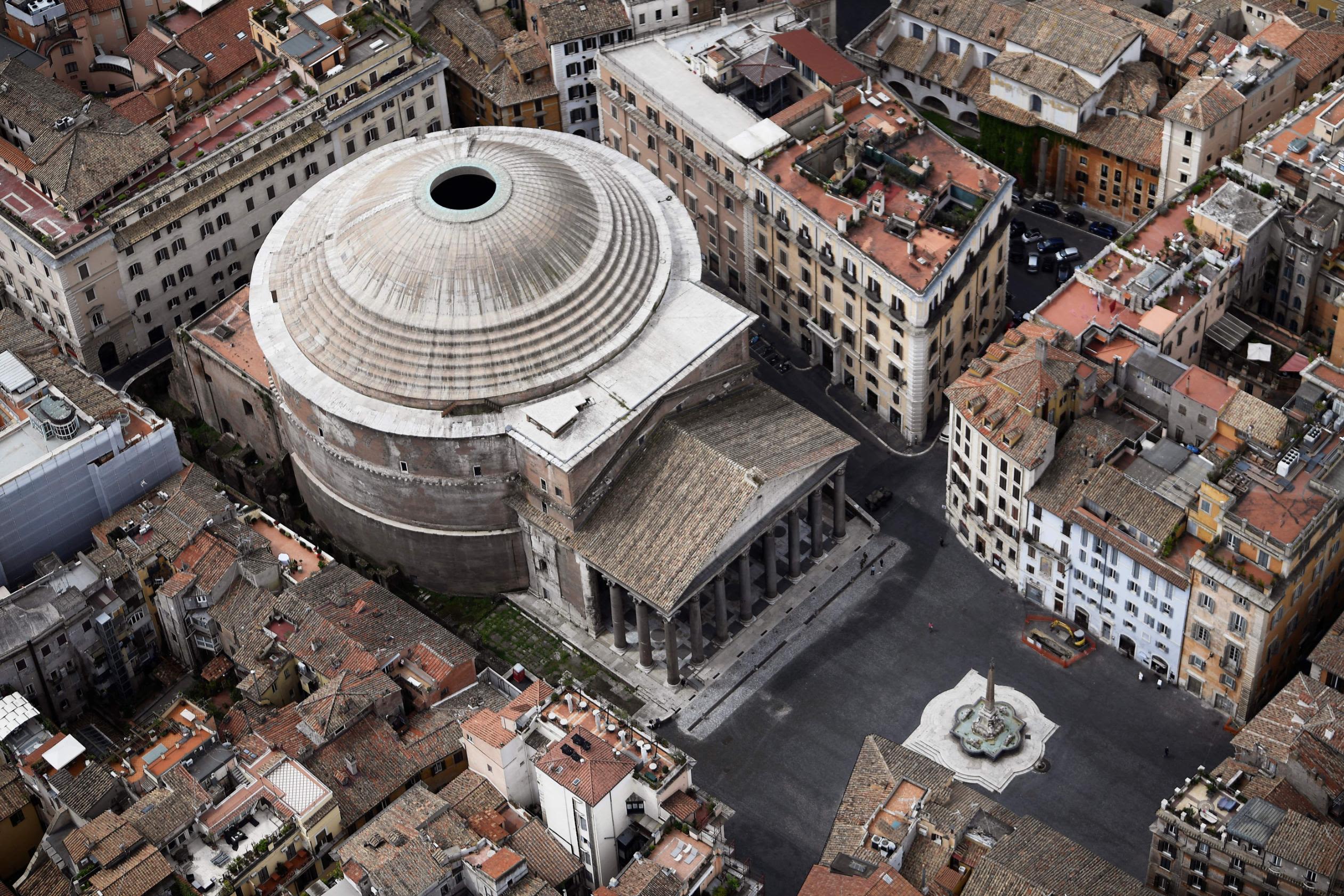
- Best-preserved Roman temple, rebuilt under Hadrian on the site of an earlier sanctuary dedicated to all the gods.
- Combines a traditional portico and pediment with a vast domed rotunda to create an overwhelming unified interior.
- Perfect, legible geometry—circle, cylinder, sphere—produces a balanced, contemplative interior.
Subject & Iconography:
- Seven wall niches in the drum linked to the seven celestial or planetary gods.
- Oculus at the dome’s apex acts as the building’s eye, evoking the heavens and introducing moving cosmic light.
- Classical Corinthian orders throughout underscore Rome’s ongoing dialogue with Greek tradition.
Formal Analysis:
- Centralised plan: axial portico flowing into a rotunda whose diameter, width, and height each measure about 44 m.
- Hemispherical dome with five diminishing tiers of coffers reduces visual and structural weight, drawing the gaze upward.
- Pilasters and columns rhythmically frame the niches below a continuous cornice from which the dome springs.
- Calculated light: an 8.3 m oculus creates a living sunbeam that animates form and marks time.
Materials & Technique:
- Roman concrete engineering grades from heavy aggregate at the dome’s base to lighter mixes ending in pumice at the crown; drum walls are brick-faced.
- Portico carries sixteen monolithic granite columns (red and grey/black Egyptian) with white marble bases and capitals; interior surfaces clad in marble revetment.
- Coffering and hidden structural systems lighten the dome while channelling loads into the drum walls rather than the columns.
Function & Context:
- Originally a Roman temple with astral and imperial associations; consecrated as Santa Maria ad Martyres in the 7th century, ensuring survival.
- Model of Roman problem-solving architecture prioritising interior space over exterior sculptural display.
- Urban monument tying imperial power to cosmic order; its influence extends through Byzantine, Renaissance, and later Western architecture.
Style & Period Features:
- Exemplifies the Roman arcuated system (arch–vault–dome) replacing Greek post-and-lintel limits.
- Monumental scale paired with mathematical clarity emphasises interior spatial drama over exterior ornament.
- Greek orders operate as decorative veneers rather than primary structural supports.
Interpretation:
- “Cosmic architecture”: the dome reads as the sky and the oculus as the sun, linking worship, empire, and the ordered universe.
- Harmonious geometry and moving light cultivate a contemplative experience aligned with Roman imperial ideology.
Comparison:
- Contrast with the Greek Parthenon’s post-and-lintel, peripteral shell and sculptural programme; the Pantheon offers a concrete dome and unified interior where columns are largely decorative.
Condition/Changes:
- Bronze roof elements and pediment fittings lost; interior marbles periodically restored or replaced.
- Continuous use preserved the structure; ancient drainage handles rainwater falling through the oculus.