
Greek Art
The introduction follows rigid Archaic frontality into Classical contrapposto and High Classical balance, before the Hellenistic drive for emotion and diagonals; the Doric, Ionic, and Corinthian orders mirror that search for harmony in architecture from the Parthenon to multi-figure sculptural programs.
Introduction
Ancient Greece developed on large peninsulas and many islands in the Mediterranean, between Europe and Asia and near Africa. The Greeks became a seafaring people because of their central position, natural harbours, mountainous terrain, and mild climate; through trade they met many cultures and learned new agricultural and metalworking techniques. After the Bronze Age city foundations and the Minoan and Mycenaean periods, self-governing city-states emerged. The Greek alphabet, adapted from the Phoenicians, helped unify communication as populations and economies grew and temples and sanctuaries were built. Constant social and economic change encouraged a questioning spirit based on observation and reason: people aimed for excellence in line with the laws of nature and placed human beings at the centre, seeking harmony between humanity and nature. The gods were anthropomorphic and related to humans through exchange (sacrifice and favour), with myths expressing ideals as well as human weaknesses. In later thought, Apollo came to represent order and clarity, while Dionysos suggested emotion and ecstasy—together expressing two strong currents in Greek culture.
Greek sculpture is often grouped into three broad phases:
- Archaic (c. 700–480 BCE): Frontality and simplified anatomy; kouroi and korai; rigid stance with the left foot advanced; clenched fists and the “Archaic smile”; patterning and Egyptian influence.
- Classical (480–323 BCE): Idealised naturalism and contrapposto; balanced proportions and calm expressions; clarity, order, and controlled motion (from the Severe Style to the High Classical).
- Hellenistic (323–31 BCE): Drama and emotion; dynamic poses and diagonals; deep carving and realism that includes age and character; complex multi-figure groups and strong movement.
Greek architecture expressed proportion, clarity, and harmony, especially in the temple—where structure and ornament were carefully ordered to reflect the same ideals as sculpture. Three column “orders” gave architects distinct visual languages while sharing a common system of column and entablature:
- Doric: Sturdy columns without bases; plain capitals; triglyph–metope frieze; strong, weighty character.
- Ionic: Slender columns with bases; volute (scroll) capitals; usually a continuous frieze; lighter, more graceful effect.
- Corinthian: Elaborate acanthus-leaf capitals; similar to Ionic in proportion; widely used later and by the Romans.
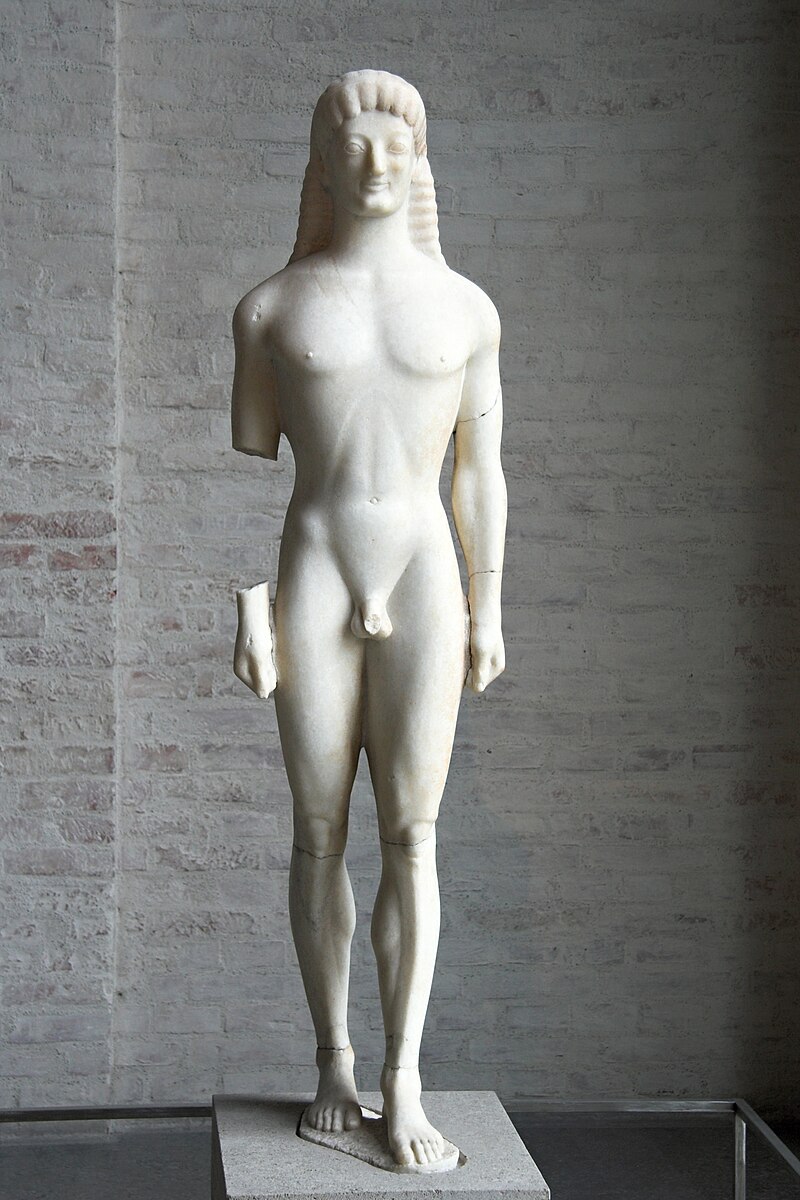
Kouros of Tenea (560–550 BC) Unknown
Snapshot:
- Early monumental freestanding statue of a nude youth (kouros) from Tenea near Corinth.
- Embodies an ideal of youthful male beauty, confidence and strength rather than a specific individual.
- Funerary context: found next to a grave; kouroi also used as sanctuary offerings.
- Egyptian-like frontal stance but with increasing Greek naturalism.
Subject & Iconography:
- Nude standing youth; arms straight at sides with clenched fists; left foot advanced; head lifted, facing forward.
- Idealised athletic body: broad shoulders, developed chest and calves, narrow waist, rounded thighs/buttocks.
- Precisely defined face with the characteristic Archaic smile; long stylised hair; impassive gaze.
Formal Analysis:
- Strict frontality and vertical symmetry; stable, rigid pose reminiscent of Egyptian statuary.
- Clear axial balance with measured step forward creating slight rhythm.
- Modelling more rounded and naturalistic than earlier kouroi, moving away from sharply outlined forms.
- Simplified, patterned treatment of hair and features; calm expression.
Materials & Technique:
- Marble; height c. 1.52 m.
- Carved in the round (subtractive).
- Surface modelling aims at smooth, ideal anatomy; stylised hair rendered in patterned masses.
Function & Context:
- Grave marker (funerary monument); comparable kouroi also dedicated in sanctuaries as offerings to the gods.
- Did not represent a particular person or god; image of ideal youth/beauty admired in a male-dominated society.
- Greek acceptance of athletic nudity (e.g., Olympia) linked to purity and showing the human free of possessions.
Style & Period Features:
- Hallmarks of the Archaic period: rigid frontal stance, symmetry, clenched fists, advanced foot, Archaic smile, stylised long hair.
- Egyptian influence in pose; Greek innovation in nudity and a shift toward naturalistic modelling.
Interpretation:
- Celebrates youthful vitality and male areté (excellence); a timeless ideal rather than a portrait.
- Suggests divine-like youthfulness that humans experience only briefly; public affirmation of admired physical ideals.
Comparison:
- Compare with Egyptian standing statues (e.g., Old Kingdom): similar frontal, striding pose and symmetry; unlike Egypt’s clothed, named ka statues, the Greek kouros is nude, unattached to a specific individual, and trends toward naturalism.
Discobolos Myron
Snapshot:
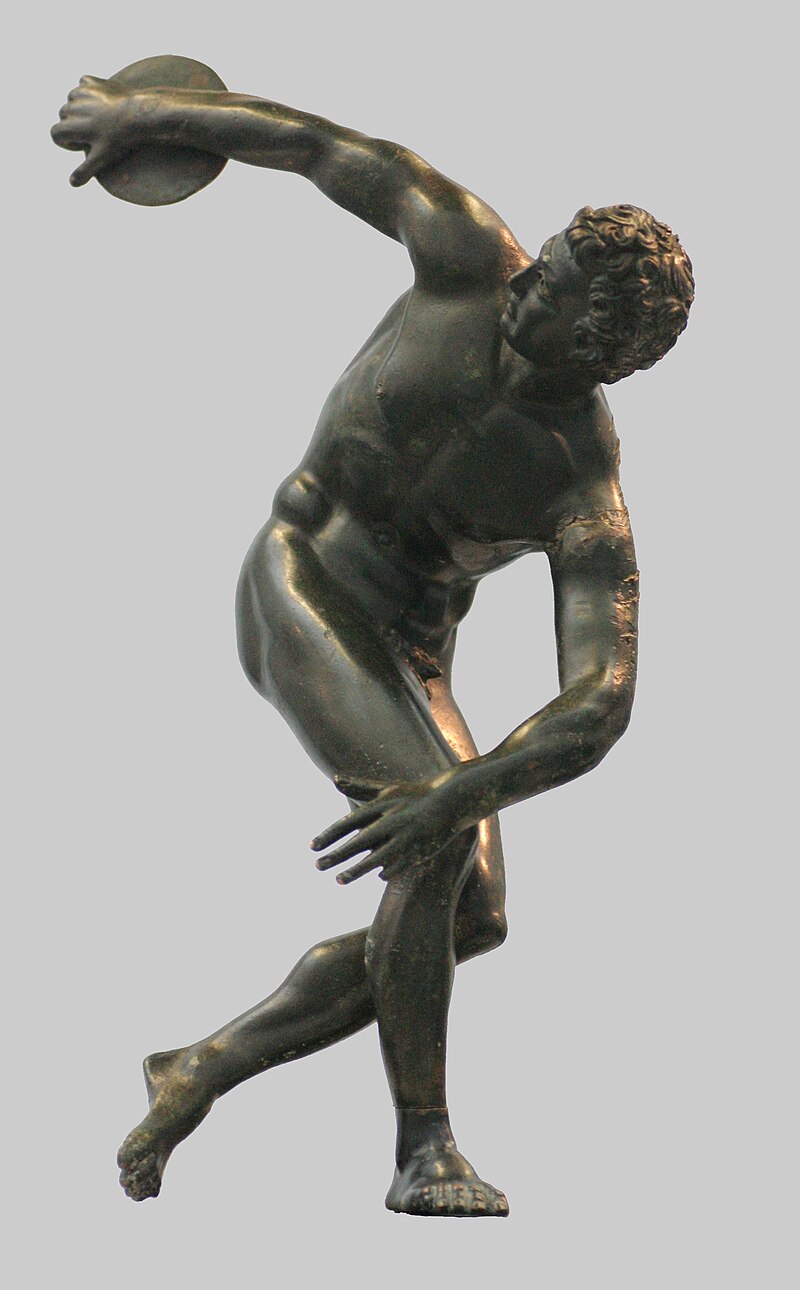
- Iconic Early Classical sculpture of a discus thrower caught at the instant before release—an ideal conception of movement.
- Balances realistic anatomy with perfect visual composition (Greek rhythmos/pattern).
- Calm, controlled face contrasts with the powerful, twisted torso—strength and excellence of the athlete.
- Popular with Romans for its athletic ideal; widely copied in marble.
Subject & Iconography:
- Nude male athlete preparing to throw the discus; body coiled, head turned.
- Embodies the Greek athletic ideal and human excellence.
- Emotionless facial expression signifies strength, control, and power.
Formal Analysis:
- Intersecting arcs: the line through the arms meets the curve of the bent knee; the forward-leaning torso links these arches.
- Upper body reads as smooth/open forms; lower half is angular/overlapping—disrupted symmetry heightens balance.
- Designed to read almost in one plane (relief-like), yet the figure can be viewed convincingly from multiple sides.
- Demonstrates liberation from rigid Archaic frontality; body moves dynamically in space.
Materials & Technique:
- Original in bronze (Greek); numerous Roman marble copies and later casts.
- Approx. life-size (c. 1.7 m high × 1.05 m wide, per handout).
- Replicas/casts on view in major museums (e.g., British Museum; National Museum of Rome).
Function & Context:
- Early Classical investigation of human action and movement in sculpture.
- Celebrates athletic excellence; ideal harmony of body and composition.
- Admired and reproduced in Roman culture for its model of the athletic ideal.
Style & Period Features:
- Early Classical (Severe Style) calm expression with observed, idealised anatomy.
- Emphasis on balanced movement and compositional order (rhythmos).
- Clear shift away from Archaic rigidity toward naturalistic action in space.
Interpretation:
- A vision of disciplined human perfection—poised energy, control, and balance just before release.
- Strength without overt emotion: virtue expressed through mastery of the body.
Comparison:
- Versus an Archaic kouros (e.g., Kouros of Tenea): Discobolos replaces rigid frontality and patterned stylisation with dynamic torsion, intersecting curves, and believable movement while keeping an idealised, composed face.
Condition/Changes:
- Original Greek bronze not present; work survives through multiple Roman marble copies and later casts displayed internationally.
Laocoön and His Sons Agesander, Athenodoros & Polydoros of Rhodes
Snapshot:
- Late Hellenistic marble group showing intense movement and emotion, contrasted with the calm balance of Classical sculpture.
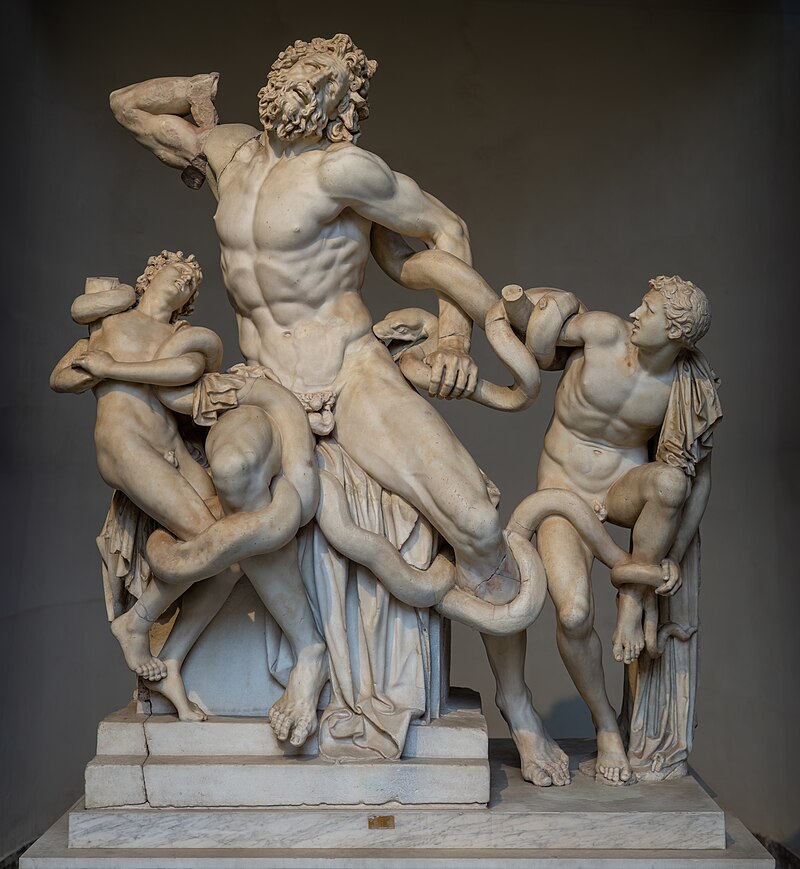
- Depicts Trojan priest Laocoön and his sons attacked by sea serpents as divine punishment.
- Rediscovered in Rome in 1506; strongly influenced Renaissance artists such as Michelangelo.
Subject & Iconography:
- Heroic struggling figures: Laocoön with sons Antiphantes and Thymbraeus, entwined by serpents.
- Narrative of divine punishment: the priest defied a god; serpents struck as he prepared an offering (sources cite Athena or Poseidon).
- Father endures the greatest torment while the left son appears softer and fading.
Formal Analysis:
- Triangular composition binds three figures as serpents coil through arms and legs.
- Strong diagonals radiate from limbs; Laocoön’s anguished face and straining torso anchor the focus.
- Balanced flanking sons plus contrasts of hair, drapery, and taut flesh heighten expression.
Materials & Technique:
- Marble group attributed to Hagesandros, Polydoros, and Athenodoros of Rhodes; virtuoso subtractive carving.
- Expressive surfaces: crisp curls and drapery contrast with taut, smooth musculature.
Function & Context:
- Reflects late Hellenistic taste for melodrama and depictions of human suffering.
- Echoes an era when art served aesthetic pleasure alongside religious meaning.
- Interpreted as a sacrificial vision of Troy’s fall and Rome’s mythic origins.
Style & Period Features:
- Hellenistic hallmarks: realism, recognisable physiognomies, intense emotion, dynamic movement, and dramatic storytelling.
- Stands in deliberate contrast to Classical restraint and balanced calm.
Interpretation:
- Emblem of human agony—suffering without redemption under divine or fated punishment.
Comparison:
- Versus Classical sculpture: swirling diagonals, torsion, and anguish replace calm equilibrium and idealised restraint.
Condition/Changes:
- Recovered in fragments; extensively restored after 1516 with debates over the priest’s missing arm.
The Parthenon in Athens Iktinos, Kallikrates & Phidias
Snapshot:
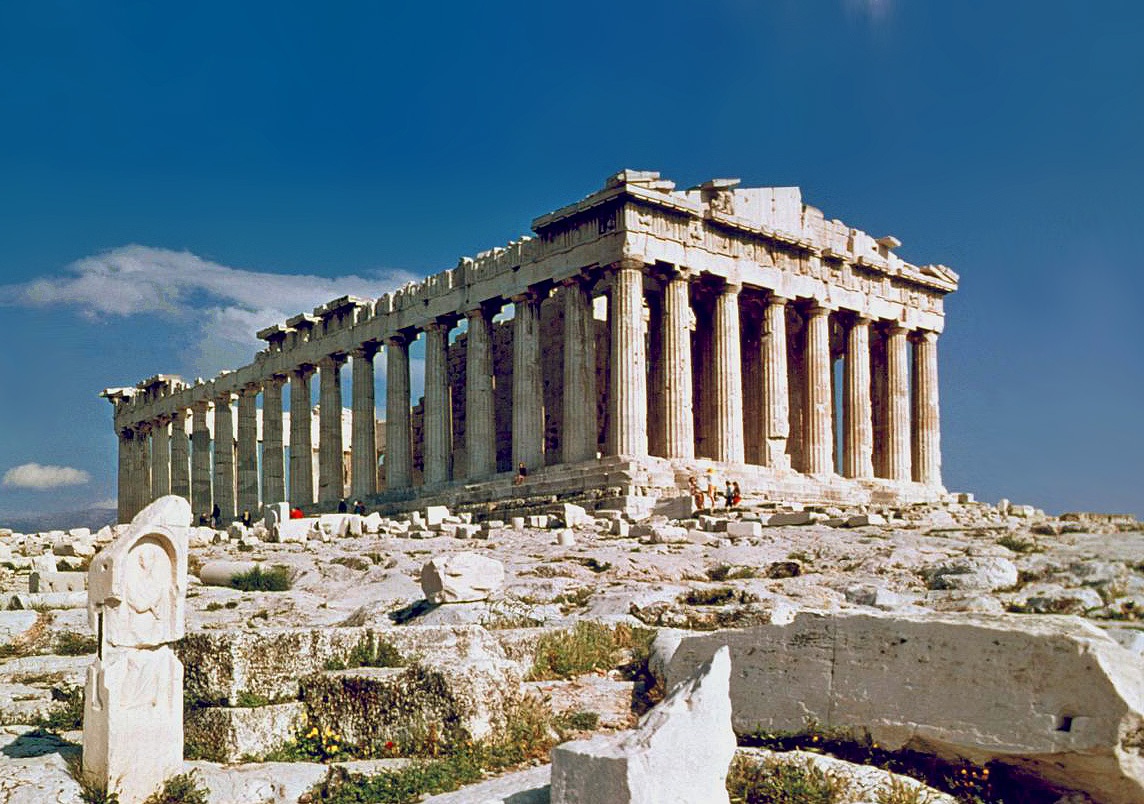
- Temple to Athena on the Acropolis; emblem of Greek harmony, balance, and simplicity.
- Doric temple widened with eight columns across the facade and twin windowless chambers (cella and treasury).
- Blends Doric structure with Ionic features such as a continuous frieze, signalling Athenian reach and influence.
Subject & Iconography:
- Housed a monumental chryselephantine statue of Athena (now lost).
- Sculptural program split across metopes, a continuous Ionic frieze, and freestanding pediment groups.
- Metopes such as Lapiths versus Centaurs advance themes of order over chaos and civic ideals.
Formal Analysis:
- Peripteral, octastyle Doric plan with a surrounding colonnade and post-and-lintel construction.
- Employs the 9:4 proportional system plus subtle curvature and column spacing adjustments to sustain visual harmony.
- Refined Doric proportions: slimmer, taller columns and a reduced entablature for elegance.
Materials & Technique:
- Constructed largely from fine white Pentelic marble, with timber reserved for doors, frames, and roofing.
- Precision-fit components: unmortared column drums pegged together; blocks tied with iron clamps sheathed in lead.
- Erected atop a stepped stylobate; column shafts assembled from stacked drums before the naos walls were enclosed.
Function & Context:
- Served as shrine and treasury for Athena’s cult image, dominating the Acropolis visually and ritually.
- Architecture and sculpture articulated civic ideals and Athenian political authority.
- Embodies the Greek temple tradition of harmonised form, balance, and symbolic decoration.
Style & Period Features:
- Classical clarity, order, and measured simplicity avoid later Hellenistic excess.
- Doric exterior integrated with Ionic features such as the continuous frieze, demonstrating stylistic synthesis.
- Mathematical harmony (9:4 ratio) and calibrated curvature reinforce visual stability.
Interpretation:
- Myth-historical reliefs like the Centauromachy proclaim the triumph of civilisation over chaos.
- The monument projects Athens as a power balancing humanism, democracy, and divine favour.
Comparison:
- Relative to earlier Doric temples, its widened octastyle front and Ionic refinements exemplify an evolved, harmonious classicism.
Condition/Changes:
- The chryselephantine cult statue is lost; much original sculpture survives only in fragments, casts, or descriptions.